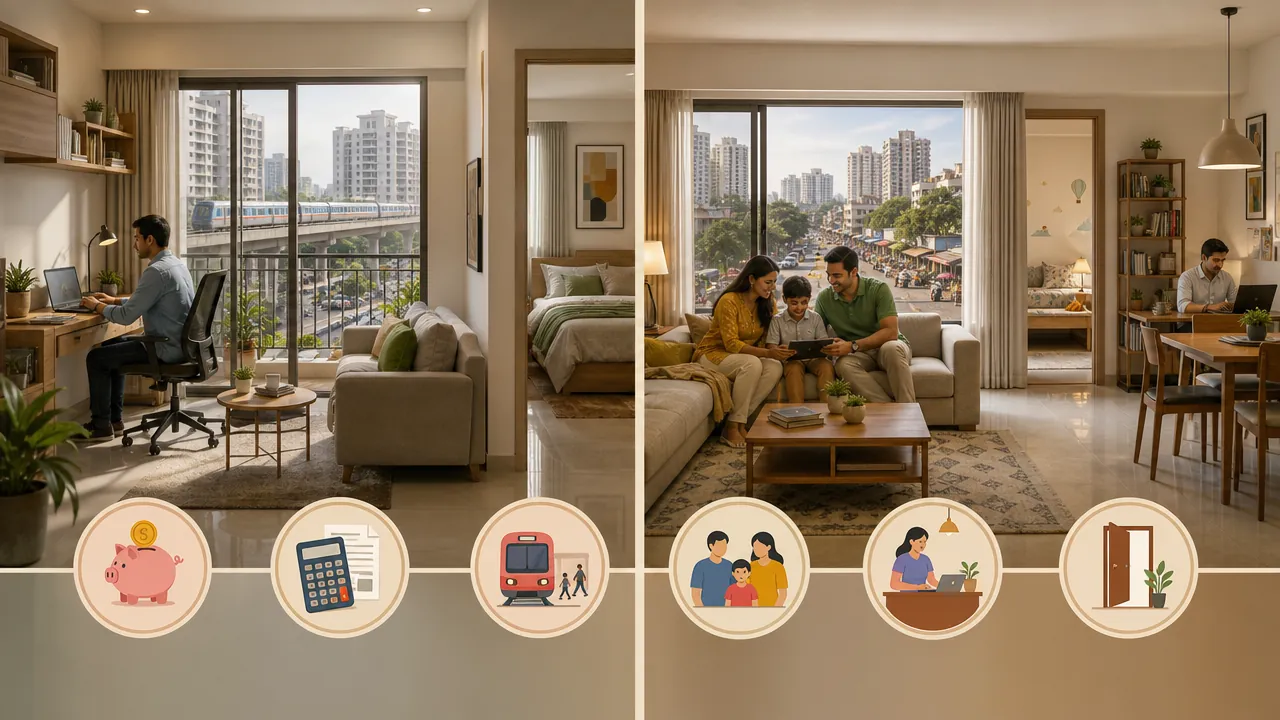
1 BHK or 2 BHK in India: How to Choose the Right Home for Your Budget and Future Needs
Choosing between a 1 BHK and a 2 BHK is not simply a question of whether you want one bedroom or two. It is a decision about affordability, location, monthly cash flow, household plans and how long you expect to stay in the property.
A 1 BHK may offer a lower purchase price and a better-connected location. A 2 BHK may provide greater flexibility for children, parents, guests, work and storage. However, the larger home is not automatically the better investment or the better choice for every buyer.
The right decision is the one that keeps the total cost manageable while giving you enough usable space for your likely needs over the next five to ten years.
1 BHK vs 2 BHK: A Quick Comparison for Indian Homebuyers
The following table offers general guidance. Actual prices, rents, maintenance charges and resale demand vary significantly by city, neighbourhood, project quality, floor plan and market conditions.
| Factor | 1 BHK | 2 BHK |
|---|---|---|
| Purchase price | Usually lower in the same project or locality | Usually higher because of the additional area and bedroom |
| EMI burden | Generally easier to manage | Higher EMI and often a larger down payment |
| Maintenance and utilities | Often lower, though charges depend on the project | May be higher because of area, common charges and usage |
| Best suited to | Singles, couples and short-to-medium holding periods | Small families, couples planning children and longer holding periods |
| Work from home | May require a flexible living or dining area | More likely to provide a dedicated office or quiet workspace |
| Storage and guests | Limited flexibility | Extra room can serve as storage, guest room or study |
| Location trade-off | May make a stronger location more affordable | May require choosing a smaller or more peripheral location at the same budget |
| Rental demand | Can be strong near offices, colleges and transport hubs | May appeal to families and professionals seeking more space |
| Resale considerations | Depends heavily on local demand and layout efficiency | May have a wider buyer pool in some family-oriented localities |
How purchase price, EMI, maintenance and usable space differ
The price difference between a 1 BHK and a 2 BHK is not limited to the extra bedroom. A larger home may also involve a larger down payment, higher loan processing charges, more expensive interiors, higher maintenance and increased utility costs.
At the same time, compare usable carpet area, not only the advertised configuration. A well-planned 1 BHK can feel more functional than a poorly designed 2 BHK with long passages, awkward corners or undersized bedrooms.
For example, a compact 1 BHK with efficient storage and a separate work niche may suit a professional better than a larger home with poor ventilation and limited usable wall space.
Which home works better for singles, couples and small families
A 1 BHK can work well for:
- A single buyer who wants to own rather than rent.
- A couple with no immediate plans to expand the household.
- A buyer who expects to relocate within a few years.
- Someone who prioritises a shorter commute and nearby daily services.
A 2 BHK may be more practical for:
- A couple planning to have children.
- A small family that needs a separate bedroom for a child.
- Buyers who regularly host guests.
- Households that require a home office, study or dedicated storage room.
- Families that may accommodate parents in the future.
How location, rental demand and resale prospects change the decision
Configuration alone does not determine rental or resale performance. A 1 BHK near a major employment hub and public transport may attract tenants more consistently than a 2 BHK in a poorly connected peripheral area. Conversely, a well-maintained 2 BHK in a family-oriented neighbourhood may have a broader buyer pool.
Evaluate the locality’s actual demand, recent transaction evidence, employment access, transport links and supply of similar homes. Avoid assuming that every 2 BHK will appreciate faster or that every 1 BHK will deliver a higher rental yield.
When a 1 BHK May Be the Better Choice
You want a lower loan commitment and more financial breathing room
A lower purchase price can reduce your down payment and monthly EMI. This may leave more room for emergency savings, investments, insurance and other life goals.
However, assess affordability using your complete budget rather than the maximum amount a lender is willing to approve. A lender’s eligibility calculation reflects repayment capacity under its criteria; it does not account for every personal priority or future risk.
A 1 BHK may be sensible if choosing a 2 BHK would require you to:
- Use nearly all your savings for the down payment.
- Stop investing for retirement or other goals.
- Depend on uncertain bonuses or irregular income.
- Carry a high EMI alongside existing education, vehicle or personal loans.
- Delay building an emergency fund.
You prefer a better-connected location over extra space
Suppose your budget allows either:
- A 1 BHK close to your workplace, rail or metro connectivity, schools, healthcare and daily shopping; or
- A 2 BHK much farther away with a substantially longer commute.
The 1 BHK may be the better overall home if the location saves hours each week and reduces transport costs. A larger floor plan does not compensate for an unsustainable commute, especially when both household members travel to different parts of the city.
You expect to live in the property for only a few years
If you may relocate for work, move to another city or upgrade after three to five years, a 1 BHK can limit your initial financial commitment. It may also be easier to rent out if the locality has strong demand from students, single professionals or young couples.
Still, account for transaction costs. Brokerage, registration, taxes, interiors and selling expenses can make a short holding period less attractive. Buy only after considering whether the property is likely to meet your needs and remain marketable during that period.
You do not need a second bedroom for work, guests or family
If the additional room would remain unused most of the time, paying for it may reduce your financial flexibility without adding much practical value. A 1 BHK can be a good fit when the living room can comfortably accommodate occasional work, guests and storage.
Before deciding, test the layout with your actual belongings. Mark out space for a desk, wardrobe, appliances, luggage and future purchases. A home that looks adequate on paper may feel cramped after furnishing.
When a 2 BHK Is Worth the Additional Cost
You are planning for children or a growing household
A second bedroom can provide meaningful flexibility when your household is likely to change soon. It can begin as a nursery, then become a child’s room, study area or shared room depending on the family’s needs.
Buying a 2 BHK may also avoid the cost and disruption of moving again shortly after purchasing a 1 BHK. But this benefit matters only if the additional EMI and ownership costs remain comfortable.
You need a dedicated home office, guest room or storage space
A second bedroom can serve different purposes across the life of the home:
- Home office for one or both earners.
- Study room for children.
- Guest bedroom.
- Storage for seasonal items and household equipment.
- Quiet room for online meetings or caregiving.
For example, a couple working from home may value two separate rooms even before having children. The second room may protect the living area from becoming a permanent office and reduce daily disruption.
You may accommodate parents or other family members
If parents may move in, even temporarily, a 1 BHK can quickly become difficult to manage. Consider privacy, accessibility, bathroom placement, lift access and whether the layout allows family members to maintain comfortable routines.
Do not rely only on the number of bedrooms. A 2 BHK with one very small bedroom and a single bathroom may not meet a multigenerational household’s needs.
You expect to remain in the home for five to ten years
A longer holding period increases the value of flexibility. Household size, work arrangements, storage needs and caregiving responsibilities can change over time.
A 2 BHK may be worth considering when the second room has a credible near-term purpose and you expect to remain in the property long enough to benefit from it. It is less compelling when the upgrade is based only on a vague possibility that the room might be needed someday.
Compare the Complete Cost of Buying a 1 BHK or 2 BHK
The quoted base price is only one part of the cost of buying a flat in India. Create an all-in cost sheet before comparing homes.
Calculate the down payment and loan-related charges
Estimate the amount you must pay from your own funds, including the portion of the purchase price not covered by the loan. Also ask the lender and developer about applicable charges such as:
- Loan processing and administrative fees.
- Technical or legal evaluation charges.
- Documentation and mortgage-related costs.
- Interest during construction, where applicable.
- Pre-EMI arrangements for under-construction homes.
Loan-to-value rules place limits on how much of the property value can be financed, with treatment depending on the loan amount and lender. Do not assume that every cost will be funded through the home loan.
Include stamp duty, registration, brokerage and parking
Your purchase budget should account for:
- Stamp duty.
- Registration charges.
- Brokerage, if applicable.
- Parking charges.
- Floor-rise or preferred-location charges.
- Legal review and document-verification fees.
- Society or maintenance deposits.
These costs can materially change the difference between a 1 BHK and a 2 BHK. Ask for a written cost sheet that separates the base price from taxes, charges and optional items.
Budget for interiors, maintenance deposits, moving and insurance
A larger home may cost more to furnish. Include wardrobes, kitchen work, lighting, curtains, appliances, painting, furniture, moving expenses and home insurance.
Also estimate recurring costs such as:
- Monthly maintenance.
- Sinking or repair fund contributions.
- Property tax, where applicable.
- Electricity, water and gas charges.
- Insurance premiums.
- Parking or club-related charges.
A 2 BHK that looks affordable at the booking stage may become uncomfortable once furnishing and recurring costs are included.
Check GST and other charges for under-construction properties
GST treatment for under-construction residential property depends on the transaction and project circumstances. It may not apply in the same way to every purchase, particularly where completion or possession status differs.
Ask for a clear written explanation of applicable taxes and charges, and verify the treatment with a qualified tax professional before making a payment. Do not rely solely on verbal assurances or informal calculations.
How to Decide Whether the EMI Is Comfortable
Build a monthly budget beyond the lender’s eligibility calculation
Start with your combined take-home income and subtract realistic monthly commitments:
- Proposed home-loan EMI.
- Maintenance and utilities.
- Existing loan repayments.
- Insurance premiums.
- Groceries and transport.
- School or caregiving expenses.
- Regular investments.
- Emergency-fund contributions.
- Expected rent during construction or a delayed possession.
The remaining amount should provide a reasonable buffer for medical costs, repairs, travel, income disruption and rising expenses.
Compare the 1 BHK home loan EMI with the 2 BHK home loan EMI
Use the same assumptions when comparing both properties: loan tenure, interest-rate scenario, down payment and additional costs. An illustrative comparison might look like this:
| Item | Illustrative 1 BHK | Illustrative 2 BHK |
|---|---|---|
| All-in purchase cost | ₹55 lakh | ₹82 lakh |
| Buyer’s upfront contribution | ₹15 lakh | ₹24 lakh |
| Approximate loan amount | ₹40 lakh | ₹58 lakh |
| Illustrative monthly EMI* | ₹36,000 | ₹52,000 |
*Illustrative figures only. Actual EMI depends on interest rate, tenure, lender, fees and loan structure.
In this example, the 2 BHK requires not only a higher EMI but also an additional ₹9 lakh upfront, before accounting for interiors and other costs. That difference may be worthwhile if the second room prevents a near-term move. It may be unsuitable if it eliminates the buyer’s emergency savings.
Account for existing debt, investments, emergency savings and rent
Stress-test both options against scenarios such as:
- One income stopping temporarily.
- A rise in interest rates where the loan is floating-rate.
- A major medical or family expense.
- A period of rent and EMI overlap.
- A job change involving a lower salary or a longer commute.
If the 2 BHK is affordable only when everything goes according to plan, it is probably too expensive.
Understand down-payment and loan-to-value requirements
A buyer must usually contribute a portion of the property cost and pay several purchase-related expenses separately. The permitted financing level can depend on the loan amount, property value, lender policies and applicable regulations.
Keep funds aside for the down payment and transaction costs without exhausting your emergency reserve. A smaller home with a healthy cash buffer can be safer than a larger home purchased with every available rupee.
Do Not Sacrifice Location Just to Upgrade from 1 BHK to 2 BHK
Compare commute time, public transport and access to daily services
Evaluate each property against practical location criteria:
- Door-to-door commute time for all earners.
- Access to public transport and major roads.
- Schools, healthcare and grocery markets.
- Flooding, water supply and power reliability.
- Safety, walkability and street lighting.
- Availability of domestic help and delivery services.
A larger home in a distant location may increase fuel, transport and time costs every month. Add these costs to your housing budget rather than comparing EMIs alone.
Weigh a smaller home in a stronger location against a larger peripheral home
Consider two realistic options:
- A 650-square-foot 1 BHK within easy reach of work and public transport.
- A 950-square-foot 2 BHK requiring two hours of daily travel and higher transport expenses.
The second property offers more room, but the first may provide a better quality of life and stronger rental demand. The answer depends on your household, work patterns and expected holding period—not on the bedroom count by itself.
Use local price and housing-market data instead of general assumptions
Compare recent local evidence for similar projects and configurations. Look at asking prices, actual transaction conditions where available, rent levels, vacancy, new supply and infrastructure changes.
National or citywide averages can provide context, but they cannot tell you whether a specific 1 BHK or 2 BHK in a particular neighbourhood is fairly priced.
1 BHK vs 2 BHK for Investment, Rent and Resale
Assess 1 BHK rental demand near employment and transport hubs
A 1 BHK may appeal to single professionals, students, young couples and workers seeking proximity to offices. Demand can be strongest when the home is near employment centres, educational institutions, public transport and everyday services.
Check actual rents for comparable homes, not advertised expectations. Also account for vacancy periods, brokerage, repairs, property management and society restrictions.
Understand why a 2 BHK may appeal to families and future buyers
A 2 BHK can attract families, couples planning children and professionals who need an office or guest room. In some localities, this may create a wider resale audience.
However, a 2 BHK may also have a higher acquisition cost, larger maintenance expenses and a longer vacancy period if local tenant demand is concentrated in smaller units.
Compare rental yield using the total acquisition cost
Rental yield should be calculated using the total amount invested, not just the base price:
Gross rental yield = Annual rent ÷ Total acquisition cost × 100
For example, if a property generates ₹3 lakh in annual rent and the total acquisition cost is ₹60 lakh, the gross yield is 5% before vacancy, maintenance, taxes, repairs and management expenses.
Compare both unit types using the same method. A 1 BHK with a higher percentage yield may still generate less absolute rent, while a 2 BHK may offer greater long-term flexibility but a lower yield.
Treat appreciation and resale value as market-dependent outcomes
Resale value depends on location, connectivity, layout, construction quality, maintenance, project reputation, legal clarity and buyer demand. No configuration guarantees appreciation.
Avoid buying a larger home solely because you expect it to deliver better returns. The property must also be affordable to hold if prices remain flat for several years.
Test Your Future Housing Needs Before Choosing a BHK
Map likely household changes over the next five to ten years
Write down plausible scenarios rather than making a decision based on a single assumption:
- Will you have children?
- Could parents move in?
- Will you need one or two workstations?
- Are you likely to change cities?
- Will your income or employment location change?
- Do you expect to host guests regularly?
- Will you acquire more furniture, equipment or storage items?
Then classify each need as likely, possible or unlikely. Pay for the second bedroom when a meaningful need is likely and the total cost is sustainable—not merely because it could be useful in an uncertain future.
Ask whether the second bedroom will have a specific near-term purpose
A simple test is to complete this sentence:
“Within the next three years, the second bedroom will be used for ______.”
If you can answer with a realistic purpose such as a nursery, office, parents’ room or study, the additional space may justify its cost. If the answer is only “extra space might be nice,” compare the benefit carefully against the higher EMI and reduced savings.
Stress-test the purchase against income changes and rising expenses
Prepare a conservative budget using current income rather than expected raises. Test what happens if:
- Your monthly household income falls by 20%.
- Your EMI rises after a rate reset.
- Maintenance increases.
- Possession is delayed and rent continues.
- A planned life event increases expenses.
The suitable property should remain manageable under a reasonable stress scenario.
Complete These Checks Before Booking the Property
Compare carpet area, layout efficiency and construction quality
Ask for the carpet area and sanctioned floor plan. Compare room dimensions, ventilation, window placement, bathroom access, storage, kitchen usability and natural light.
Inspect construction quality, water pressure, lifts, fire safety systems, common areas, parking access and the condition of the building or sample unit. Do not assume a higher price means better construction.
Verify RERA registration, sanctioned plans and possession information
For an applicable project, verify its registration and disclosures through the relevant state real estate regulatory authority. Check the registered project details, promoter information, approved plans, proposed completion date, approvals and updates.
Treat possession dates in advertisements as provisional until supported by project documentation. Delays can create a significant rent-and-EMI burden.
Review title documents, agreement terms and promised amenities
Have qualified legal and property professionals review relevant documents, including:
- Title and ownership records.
- Encumbrance and approval information.
- Sanctioned plans.
- Sale agreement and payment schedule.
- Possession and delay clauses.
- Cancellation and refund conditions.
- Specifications and promised amenities.
- Maintenance and handover terms.
Ensure that important promises are recorded in the agreement or official project documents rather than relying on sales conversations.
Check maintenance costs, possession risk and project disclosures
Ask for current or projected maintenance charges, corpus contributions, parking arrangements, water and power provisions, society rules and expected handover responsibilities.
For resale homes, inspect past maintenance records, pending repairs, disputes and outstanding dues. For new homes, investigate the developer’s delivery record and project-level disclosures.
Should You Buy a 1 BHK or 2 BHK? A Practical Decision Rule
Choose a 1 BHK when:
- The second bedroom would probably remain unused.
- The larger home would weaken your emergency fund or investments.
- A 1 BHK allows you to buy in a significantly better location.
- You expect to relocate or upgrade within a few years.
- The layout comfortably supports your current lifestyle.
Choose a 2 BHK when:
- The extra room has a credible near-term purpose.
- You expect to stay for at least five to ten years.
- The EMI remains comfortable after accounting for all household costs.
- You can fund the down payment without exhausting your reserves.
- The location, construction quality and legal documentation remain acceptable.
Tax benefits may apply to eligible home-loan borrowers under applicable conditions. For example, interest deductions for a self-occupied home are subject to the relevant tax rules and limits. Tax savings should be treated as a secondary consideration—not as a reason to stretch beyond your comfortable budget. Confirm your position with a qualified tax adviser.
Final 1 BHK vs 2 BHK Home-Buying Checklist
Before booking, compare both options on the following points:
- All-in purchase price, not only the advertised base price.
- Down payment and transaction costs.
- 1 BHK home loan EMI versus 2 BHK home loan EMI.
- Maintenance, utilities, insurance and property-related expenses.
- Usable carpet area and layout efficiency.
- Commute time and transport costs.
- Access to schools, healthcare and daily services.
- Emergency savings after the purchase.
- Existing debt and future financial commitments.
- Likely household changes over five to ten years.
- Rental demand and resale prospects in the specific locality.
- Construction quality and project delivery record.
- RERA registration and project disclosures, where applicable.
- Title documents, sanctioned plans and agreement terms.
- Possession risk and the possibility of rent-and-EMI overlap.
Frequently Asked Questions
Is a 1 BHK or 2 BHK better for first-time buyers?
Neither is universally better. A 1 BHK may be suitable when affordability, location and a lower loan commitment are priorities. A 2 BHK may be better when the buyer expects children, needs a home office or plans to remain in the property for several years. Choose based on complete cash flow and future use rather than status or assumptions.
Is a 1 BHK cheaper to maintain than a 2 BHK?
Often, but not always. Maintenance may depend on carpet area, the project’s rate structure, common facilities, parking, sinking funds and society rules. Request the exact monthly and one-time charges for both properties before deciding.
Is a 2 BHK always better for resale?
No. Resale depends on locality, transport, layout, condition, project quality, pricing and buyer demand. A well-located, efficiently planned 1 BHK can be easier to sell than an overpriced 2 BHK in a weak location.
Should I buy a 1 BHK as an investment property?
A 1 BHK may work as an investment near employment hubs, colleges or transport nodes if tenant demand is proven. Compare expected rent with the total acquisition cost, vacancy, maintenance and financing costs. Do not assume rental demand or appreciation without local evidence.
How much EMI can I comfortably afford?
There is no single percentage that works for every household. Start with take-home income, subtract all existing and expected expenses, retain emergency savings and test the budget against income disruption and rising costs. Loan eligibility is not the same as comfortable affordability.
Does a second bedroom justify a higher home loan?
It can, when the room has a clear near-term use and the higher total cost remains sustainable. It may not be worthwhile when it forces a much longer commute, eliminates savings or is likely to remain unused.
What should I compare besides the BHK number?
Compare carpet area, room dimensions, ventilation, natural light, storage, bathrooms, parking, maintenance, construction quality, location, possession timeline, legal documents and total acquisition cost. These factors often matter more than the label itself.
Can tax benefits make a 2 BHK affordable?
Tax deductions may reduce taxable income for eligible borrowers, subject to applicable conditions and limits. They should not be the primary reason to take a larger loan. Make sure the EMI is affordable before considering any potential tax benefit.
Make the Decision Based on Use, Not Just Size
The best BHK for you is the home that balances space, location, affordability and flexibility. Choose a 1 BHK when it meets your foreseeable needs without compromising your financial security. Choose a 2 BHK when the additional room has a realistic purpose, supports your household plans and remains affordable after every ownership cost is included.
Shortlist both configurations, calculate their true monthly cost, compare local market evidence and review the project documents carefully. Before making a booking decision, speak with a qualified lender, tax professional and property adviser where appropriate.