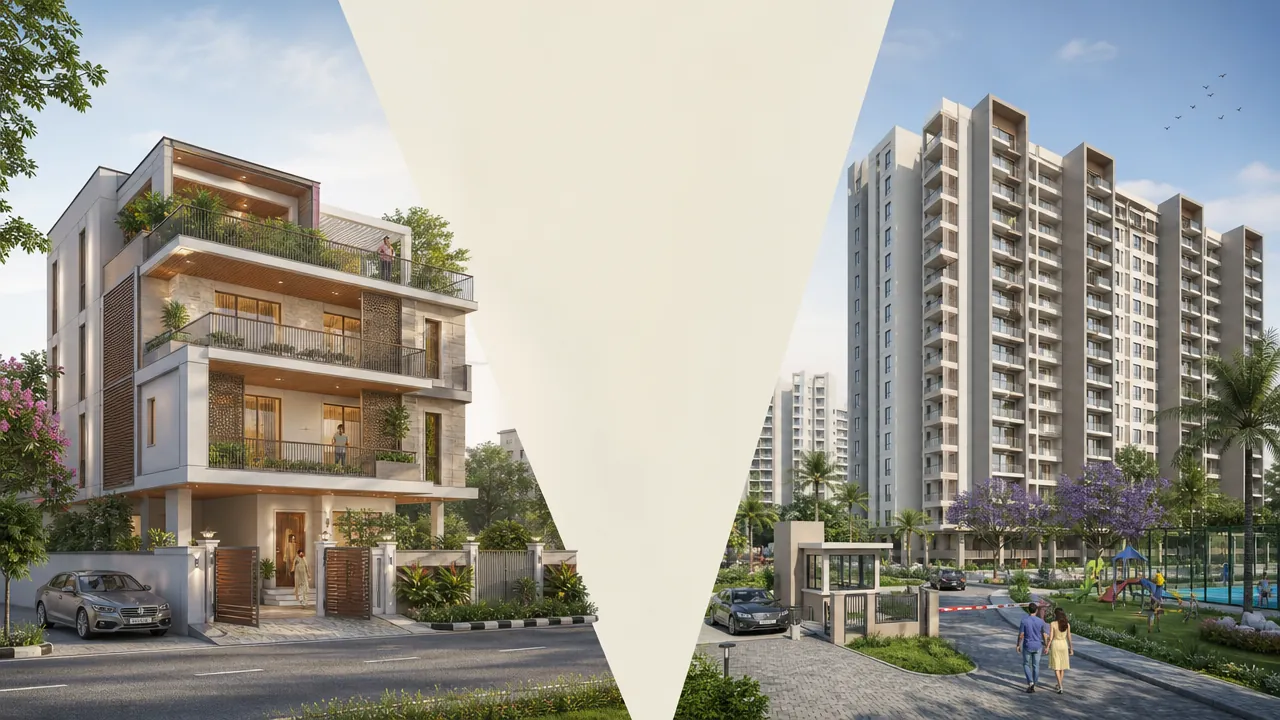
Builder Floor or Apartment in India? Compare Privacy, Ownership, Costs and Long-Term Value
Choosing between a builder floor and an apartment is not simply a choice between more space and more amenities. The right decision depends on ownership rights, construction quality, maintenance, possession risk, financing and resale demand.
A practical comparison of builder floor vs apartment in India should focus on the property documents and total cost—not just the brochure or property label.
Builder Floor vs Apartment: What Is the Difference?
A builder floor is usually an independent floor in a low-rise building, often with fewer homes and separate or semi-independent access. An apartment is generally a unit within a multi-storey building or a managed residential project with shared facilities and common services.
These are broad descriptions, not legal definitions. A builder floor may involve shared land ownership, a common staircase, a lift or a jointly owned roof. An apartment buyer may own the unit along with an undivided share in the land and common areas.
Ownership, land share, parking and common-area rights
Before comparing prices, establish exactly what you will own and use:
- The carpet area and boundaries of the home
- Your undivided share in the land, where applicable
- Rights over corridors, staircases, lifts, terraces and entrances
- Whether parking is allotted, licensed or legally transferable
- Responsibility for the building structure, roof, utilities and repairs
- Access to amenities and restrictions on their use
Do not assume that buying the top floor means owning the terrace, or that paying for a parking space creates exclusive ownership. The title documents, sale agreement, sanctioned plan and association or society documents should establish these rights.
Privacy, Lifestyle and Daily Management
Builder floor advantages: lower density and more independent access
A builder floor may suit buyers who value fewer neighbours, less floor-to-floor interaction and a quieter setting. Independent entrances, private staircases or a lower number of homes can provide a greater sense of control.
However, privacy depends on the actual layout. A shared entrance, common driveway, adjacent construction or multiple families using the same services can reduce that advantage. Low-rise construction also does not automatically mean better sound insulation or superior build quality.
Apartment advantages: security, amenities and managed common areas
Apartments may offer security staff, lifts, power backup, parking management, gyms, children’s areas, clubhouses and landscaped spaces. These facilities can be valuable for families, older residents and buyers who prefer organised maintenance.
The trade-off can include higher density, visitor rules, noise, shared walls and less flexibility for renovations. Security systems and amenities also work only when the society maintains them properly.
Society rules, neighbour interaction and maintenance responsibilities
An apartment buyer should review society or association rules covering pets, renovations, rentals, parking, common-area use, exterior changes and move-in charges. A builder-floor buyer should document who pays for lift maintenance, security, water pumps, common electricity, painting and structural repairs.
Ask specifically:
- Who repairs the roof or terrace after water leakage?
- Who maintains the lift, if one exists?
- Are water, sewage and power systems individually metered?
- Can owners make changes to the façade or common areas?
- Is there a written arrangement for future repairs and redevelopment?
Compare the Total Cost of Buying and Owning the Home
The cheaper advertised price may not be the cheaper home. Prepare a written cost sheet for both options.
Upfront costs
Include the base price, stamp duty, registration, legal review, brokerage, parking, floor-rise or other charges, utility connections, interiors, appliances and moving expenses. Compare carpet area rather than only the quoted built-up or super built-up area.
A builder floor may require more spending on wardrobes, security systems, power backup or common infrastructure. An apartment may include amenities but charge separately for parking, clubhouse access, deposits or initial maintenance.
Recurring costs
For an apartment, estimate monthly maintenance, sinking-fund contributions, security, lift operation, common electricity, water systems and amenity charges. Check whether dues can increase and how arrears are recovered.
For a builder floor, recurring charges may appear lower, but owners may have to fund major repairs directly. A roof replacement, external painting, waterproofing, plumbing failure or lift repair can create a large one-time expense.
Under-construction costs
For an under-construction property, calculate rent during construction, pre-EMI or loan interest, GST where applicable, registration-related charges and the cost of delayed possession. A lower launch price can lose its advantage if delivery is late.
Also compare ready-to-move homes with completed documentation and visible construction quality. The decision should account for both money and uncertainty, not only the initial price.
Legal, Construction and Possession Risks to Check
Before signing or paying a substantial amount, have an independent property lawyer verify:
- Title and ownership chain
- Encumbrances, mortgages and litigation
- Sanctioned building plans and permitted use
- Completion or occupancy documentation, where applicable
- RERA registration and project disclosures, where applicable
- Saleable carpet area and the agreed layout
- Parking and common-area rights
- Possession date, payment schedule and cancellation terms
Protect carpet area, layout and specifications
The agreement should clearly state the carpet area, floor plan, specifications, fittings, parking arrangement and delivery obligations. A change in flat size or layout can affect the price, loan eligibility, taxes and future value.
Do not rely on verbal assurances that the final home will match a model unit. Record promised materials, brands, amenities and timelines in the agreement and retain approved plans and payment receipts.
Understand delay remedies and compensation
Check what happens if possession is delayed: interest, compensation, cancellation, refund and applicable legal remedies. In a reported Gurgaon dispute, a buyer received a refund of about ₹1.73 crore with 12% interest after a delayed project. The case illustrates why possession obligations and remedies should be reviewed before commitment.
RERA can provide important protections, but coverage and remedies depend on the project, transaction and applicable law. A lawyer can help determine the available route rather than assuming every dispute has the same outcome.
Which Has Better Long-Term Value: Builder Floor or Apartment?
Neither format always appreciates more. Compare the factors that influence demand in the specific location:
- Connectivity, employment hubs and neighbourhood development
- Land component and clarity of ownership rights
- Construction quality and building age
- Parking, access and independent entrances
- Rental demand from the likely tenant profile
- Apartment maintenance and society finances
- Resale liquidity and buyer financing eligibility
- Redevelopment potential and local building rules
A well-built builder floor with clear title, usable parking and strong local demand may outperform a poorly maintained apartment. Conversely, a professionally managed apartment in a desirable project may be easier to rent, finance and resell than an independently managed low-rise property.
Builder Floor or Apartment: A Buyer Decision Matrix
A builder floor may suit you when:
- You prioritise lower density and greater privacy
- Independent access matters more than shared amenities
- You can assess construction quality personally
- The title, land share and parking rights are clear
- You are prepared to coordinate repairs and common expenses
An apartment may suit you when:
- Security, lifts and managed facilities are important
- You prefer formal maintenance and association processes
- Your household benefits from amenities or controlled access
- You want a project with established rental and resale demand
- You accept society rules and recurring maintenance charges
These are decision criteria, not guarantees. The best choice is the property with stronger documents, construction, location and total-cost economics.
Final due-diligence checklist
Before booking either home, verify the title, sanctioned plan, encumbrance position, RERA record where applicable, carpet area, parking rights, possession date, delay remedies, construction quality, maintenance terms, complete acquisition cost, loan eligibility, rental demand and resale prospects. Have an independent lawyer review the documents before signing or transferring funds.