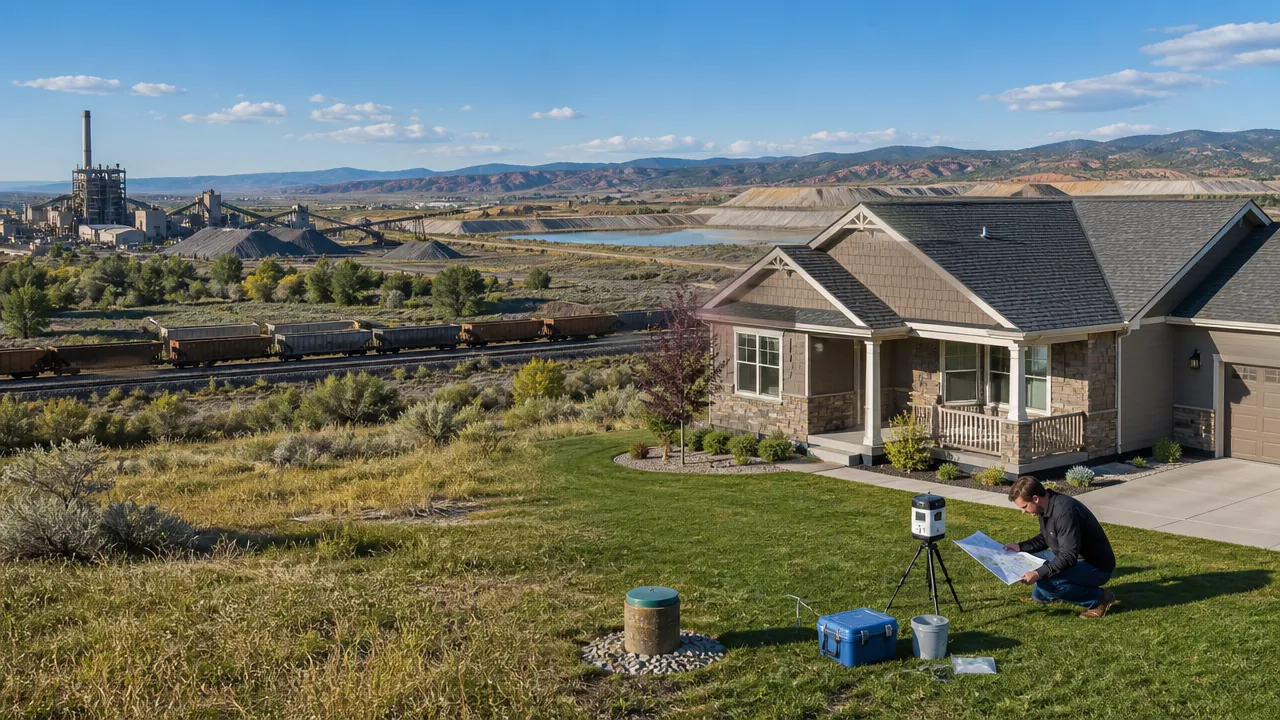
Buying a Home Near Mining or Industrial Areas? How to Check Air Quality and Environmental Risks
A home near a mine, factory, refinery, landfill, rail yard, power plant, or former industrial site may be affordable and convenient—but it deserves more than a standard visual inspection. Environmental risks when buying a home are not determined by distance alone. They depend on what was released, how it can move, whether people can be exposed, how the property is used, and whether the risk is controlled or legally documented.
The right approach is to investigate the property through several exposure pathways: outdoor air, soil, groundwater, indoor air, drinking water, flooding, and physical hazards such as mine subsidence. Public databases are a useful starting point, but they are not a substitute for property-specific testing.
A nearby facility or pollution record is a reason to investigate—not automatic proof that the home is unsafe.
This guide explains how to screen the neighborhood, identify warning signs, arrange professional environmental due diligence, and protect yourself before closing.
Why Distance Alone Does Not Reveal Environmental Risks When Buying a Home
A home several miles from an industrial facility may face a greater risk than a home closer to it if wind, drainage, groundwater flow, or local topography carry contaminants toward the property. Conversely, a facility located nearby may present limited residential exposure if its operations are well controlled and the relevant contaminants cannot reach the home.
Evaluate each pathway separately:
- Outdoor air: Particulate matter, smoke, gases, odors, and industrial emissions may vary by wind, season, and operating conditions.
- Soil: Historic spills, mine waste, airborne dust, fill material, and lead-containing residues may remain in yards or gardens.
- Groundwater: Chemicals can migrate underground from leaking tanks, landfills, industrial sites, mines, or waste-disposal areas.
- Indoor air: Vapors from contaminated soil or groundwater can enter through foundations, cracks, drains, sumps, and utility penetrations.
- Drinking water: Private wells may be affected by local contamination even when municipal water is treated and monitored.
- Flooding and stormwater: Floods can spread pollutants from industrial properties, waste sites, mine workings, or contaminated soil.
- Physical hazards: Mines may create risks from subsidence, abandoned openings, blasting, unstable tailings, and mine waste.
A record of a chemical release does not, by itself, show that the property has dangerous indoor concentrations. To assess significance, ask four questions:
- What substance or physical hazard is involved?
- Could it reach the property or the people living there?
- At what concentration or severity?
- Are there controls, cleanup measures, monitoring, or legal restrictions that manage the risk?
Start With a Map of Nearby Industrial and Mining Sources
Begin with a detailed map of the property and the surrounding area. Search for both current and historical sources, including:
- Factories, refineries, smelters, and power plants
- Active, inactive, and abandoned mines
- Landfills, waste-transfer stations, and disposal areas
- Former dry cleaners, gas stations, and fuel terminals
- Rail yards, truck depots, and major freight routes
- Underground storage tanks and pipeline corridors
- Industrial parks and former manufacturing properties
- Wastewater-treatment facilities and large agricultural operations
Do not stop at the nearest property boundary. Review the surrounding drainage basin, waterways, and groundwater direction where information is available. A home downhill from a facility or adjacent to a drainage channel may have a different risk profile from a home at a similar distance but on higher ground.
Prevailing wind direction is also important. Look at typical wind patterns as well as unusual conditions such as temperature inversions, which can trap pollution near the ground. A local air-quality agency, meteorological records, or an environmental consultant may help interpret these patterns.
Also note planned changes. A proposed plant expansion, new waste-processing operation, mine permit, rail facility, or change in production could affect future noise, traffic, dust, emissions, and resale value.
Check Current and Historical Air Quality Near the Property
Air quality should be assessed across different times—not just on the day of a showing. Review available readings for:
- PM2.5: Fine particles that can travel deep into the lungs
- PM10: Larger airborne particles often associated with dust and industrial activity
- Ozone: A regional pollutant that can be elevated far from its original source
- Smoke: From wildfires, prescribed burns, or industrial incidents
- Sulfur dioxide, nitrogen dioxide, and other facility-specific pollutants: Where monitoring is available
Use the national Air Quality Index and records from state or local air-quality agencies to understand current and historical conditions. Compare weekday and weekend patterns, warm and cold seasons, and periods when the facility is likely to operate at higher capacity.
Air-quality monitors may be several miles away and may not capture conditions at the individual home. That limitation does not make the records useless; it means they should be interpreted as regional evidence rather than a direct measurement of indoor exposure.
Look for additional indicators:
- Repeated odor or dust complaints
- Visible plumes or settled dust
- Emissions-monitoring results
- Permit limits and required controls
- Notices of violation and enforcement actions
- Proposed expansions or permit modifications
- Community reports of nighttime or seasonal problems
A single odor does not prove harmful contamination, and an absence of complaints does not prove clean air. Odors can be noticeable below harmful levels, while some hazardous pollutants may have little or no odor.
Search EPA and State Records for Nearby Pollution Sources
Government databases can reveal facility histories that are not obvious during a showing. Search the address and surrounding area using tools such as:
- EPA ECHO: Facility permits, inspections, violations, enforcement actions, and compliance information
- EPA Envirofacts: Multiple environmental datasets organized by facility and location
- Toxics Release Inventory: Certain chemical releases, transfers, and waste-management activities reported by qualifying facilities
- State environmental-agency databases for air permits, spills, cleanup actions, waste sites, and groundwater monitoring
- Local planning and zoning records for proposed industrial or mining activity
Treat a facility listing or Toxics Release Inventory report as a screening signal, not a final safety conclusion. A report may show that a facility handled or released a chemical, but it may not establish that the chemical reached your property or that residents were exposed at a harmful level.
For each potentially relevant facility, identify:
- The chemicals involved and their physical properties
- Whether releases were to air, water, soil, or an off-site waste facility
- The quantities and reporting period
- The facility’s compliance and enforcement history
- Prevailing winds and drainage connections
- Whether contamination was investigated or remediated
- Whether operations or permits are expected to change
Investigate Soil, Groundwater, and Waste Contamination
Environmental risks can remain after an industrial operation closes. Search for records involving:
- Superfund or other major cleanup sites
- Brownfield redevelopment
- Hazardous-waste treatment, storage, or disposal
- Underground storage tanks
- Historic spills and emergency releases
- Landfills and illegal dumping
- Mine tailings, slag, ash, or waste rock
- Groundwater plumes and private-well advisories
If a cleanup has occurred, do not assume the property is unrestricted. Determine whether the cleanup was approved for residential use, which standards were applied, and whether contamination remains below buildings or elsewhere on the site.
Ask for documentation showing:
- The contaminants found
- Sampling locations and laboratory results
- The cleanup plan and completion report
- Any remaining contamination
- Restrictions on digging, gardening, groundwater use, or construction
- Required monitoring, inspections, or maintenance
- Institutional controls recorded with the property
For example, a site may be considered suitable for residential use only if a protective soil cover remains intact. Future owners may be prohibited from removing that cover or installing a drinking-water well. Those obligations should be understood before purchase and confirmed in writing.
Understand Vapor Intrusion Before Buying Near a Former Industrial Site
Vapor intrusion occurs when volatile chemicals in contaminated soil or groundwater migrate upward and enter a building. Vapors may move through foundation cracks, floor drains, sumps, utility openings, crawl spaces, or other pathways.
Pay particular attention to homes near:
- Former dry cleaners
- Gas stations and auto-service properties
- Fuel terminals
- Solvent-using manufacturers
- Industrial properties with known groundwater plumes
- Landfills or waste sites containing volatile chemicals
A home may have a sub-slab depressurization system, vapor barrier, passive venting system, or other mitigation equipment. Ask:
- Why was the system installed?
- What chemicals prompted the installation?
- Is it operating continuously?
- Who pays for electricity, inspections, and repairs?
- Are indoor-air or sub-slab samples collected regularly?
- Are there notices or restrictions recorded against the property?
Do not disable mitigation equipment before receiving professional advice. If vapor intrusion is plausible, a qualified consultant may recommend sub-slab soil-gas, indoor-air, or other targeted sampling. Testing should account for weather, building pressure, heating systems, and other factors that can influence results.
Hire a Professional for Environmental Due Diligence
A general home inspection is not the same as an environmental assessment. When the property history or surroundings raise concerns, consider hiring a qualified environmental consultant.
A Phase I Environmental Site Assessment reviews the property’s current and historical uses, nearby facilities, environmental databases, aerial photographs, records, and site conditions. It is designed to identify potential or recognized environmental conditions. It typically does not include sampling.
A Phase I may be especially useful when:
- The property was formerly commercial or industrial
- A nearby facility used solvents, fuels, metals, or hazardous chemicals
- There is evidence of fill, dumping, staining, spills, or buried tanks
- The property is near a landfill, mine, rail yard, or waste site
- A lender, insurer, or investor requires environmental documentation
If the Phase I identifies a recognized environmental condition, a Phase II Environmental Site Assessment may be appropriate. This can involve sampling of soil, groundwater, soil gas, indoor air, surface water, or building materials.
Testing should be targeted. A soil sample may not answer a vapor-intrusion question, and a groundwater sample may not reveal contamination in the home’s indoor air. Ask the consultant to explain the suspected source, pathway, sampling design, detection limits, and how results will be compared with applicable residential standards.
Check Mining-Specific Hazards Beyond Air Pollution
Buying a home near a mine involves hazards that may not appear in ordinary pollution records. Investigate:
- Abandoned mine openings, shafts, and tunnels
- Ground subsidence or sinkholes
- Unstable highwalls and waste piles
- Tailings, slag, and mine-waste deposits
- Acid mine drainage and metal contamination
- Blasting, vibration, noise, and dust
- Changes in groundwater levels or flow
- Reclamation obligations and incomplete restoration
Search federal and state mining databases, mine maps, permit records, reclamation files, and abandoned-mine inventories. Local building, planning, and emergency-management offices may also have mine maps or subsidence information.
A property can appear stable at the surface while old underground workings create a future settlement risk. If subsidence is plausible, obtain an opinion from a qualified geotechnical or mining engineer. Ask whether additional surveying, structural review, or title research is needed.
Also investigate the mine’s future. An inactive mine may reopen, expand, undergo reclamation, or change its water-management practices. An active mine may have approved blasting schedules, haul routes, and operating boundaries that affect daily life and resale.
Review Flooding, Wildfire Smoke, and Industrial-Release Risks
Pollution and physical climate risks should be reviewed separately. Use official flood maps, local drainage information, elevation data, and recent storm history to assess flood exposure.
Flooding can affect a property in two ways: direct water damage and movement of contaminants. Floodwater may carry fuel, waste, sewage, mine residues, or contaminated sediment onto residential land. Ask whether nearby facilities have spill-response plans and whether the property lies downstream from industrial or waste sites.
Also consider:
- Stormwater overflow from paved industrial areas
- Erosion of mine waste or contaminated soil
- Wildfire smoke and regional air-quality events
- Emergency access during floods, fires, or industrial incidents
- Insurance availability, exclusions, and future premium changes
A home may have acceptable industrial-air conditions but still face significant flood or smoke exposure. These risks can affect health, maintenance costs, insurance, and long-term resale value.
Test the Home and Its Water, Not Just the Neighborhood
Neighborhood databases cannot tell you everything about the house itself. Consider property-specific testing and inspection for:
- Radon: A naturally occurring radioactive gas that can accumulate in basements and crawl spaces
- Lead-based paint: Especially important in older homes
- Lead in soil: A concern near historic smelters, busy roads, industrial operations, and older painted structures
- Lead in drinking water: Check plumbing materials and test tap water where appropriate
- Private-well water: Test for metals, volatile chemicals, petroleum compounds, bacteria, and other contaminants based on local conditions
- Basements and crawl spaces: Look for odors, dampness, staining, sumps, floor drains, cracks, and unusual ventilation
- Existing mitigation systems: Confirm their purpose, condition, monitoring, and maintenance history
For a private well, do not rely solely on a generic annual test. The testing panel should reflect nearby facilities, known groundwater contamination, local geology, and the well’s construction. A qualified water professional or public-health agency can help identify appropriate tests.
Use This Pre-Closing Environmental Inspection Checklist
Before environmental and inspection contingencies expire:
- Map active and historical mines, factories, landfills, rail yards, fuel sites, and waste facilities.
- Review prevailing winds, drainage, waterways, elevation, and flood exposure.
- Check current and historical air-quality records across different seasons.
- Search government facility, cleanup, mining, spill, storage-tank, and waste databases.
- Request seller disclosures, prior inspections, environmental reports, well records, and remediation documents.
- Inspect for odors, dust, staining, vents, sumps, floor drains, fill, mine waste, and mitigation equipment.
- Order targeted testing for radon, soil, water, soil gas, indoor air, or building materials as appropriate.
- Ask a qualified consultant whether a Phase I or Phase II assessment is warranted.
- Confirm lender, insurer, zoning, and local disclosure requirements.
- Put access rights, testing permissions, remediation duties, credits, and cancellation rights in writing.
Do not wait until the final days before closing. Environmental testing, laboratory analysis, consultant review, and government-record requests can take longer than a standard inspection.
Decide Whether the Environmental Risk Is Acceptable
There is no universal distance that makes every home near an industrial or mining area safe or unsafe. Make the decision using the evidence available:
- What contaminant or hazard is involved?
- Is there a complete pathway to the home or its occupants?
- What are the measured concentrations or predicted impacts?
- What cleanup standard applies to residential use?
- Are controls, monitoring, and maintenance reliable?
- Are legal restrictions clear and transferable?
- Could future operations increase the risk?
- Will insurance, financing, or resale be affected?
A documented cleanup with functioning controls may be acceptable to one buyer. Another buyer may not want a home requiring long-term monitoring, restricted gardening, private-well limits, or mechanical vapor mitigation.
Consider walking away when records are incomplete, testing is refused, contamination cannot be adequately characterized, controls are not maintained, or the contract does not provide enough time and authority to investigate. An attractive price is not compensation for an environmental risk you cannot understand or manage.
Before closing, map nearby sources, review public records, request seller documents, and arrange targeted testing when the evidence warrants it. If significant risks remain unresolved, ask your real-estate agent or attorney to protect your contingencies before you commit.
Frequently Asked Questions
Is buying a home near a factory automatically unsafe?
No. Safety depends on the facility’s operations, emissions, controls, compliance history, location, wind and drainage patterns, and the presence or absence of a complete exposure pathway. A nearby facility should prompt investigation, not an automatic conclusion.
How far should a home be from a mine or industrial facility?
There is no universal safe-distance rule. The appropriate separation depends on the pollutant, facility type, terrain, prevailing winds, groundwater, operating conditions, and regulatory requirements. A consultant can help evaluate site-specific conditions.
Is a pollution database enough to decide whether to buy?
No. Databases are valuable screening tools, but they may contain incomplete, outdated, or facility-level information. Confirm the source, pathway, concentration, cleanup status, and effect on the specific property through documents and, when needed, professional testing.
Do I need a Phase I Environmental Site Assessment for every home purchase?
Not necessarily. A Phase I is more relevant when a property has an industrial or commercial history, lies near a potentially contaminating facility, is near a mine or waste site, or raises concerns during records research. A consultant can help determine whether it is proportionate to the risk.
What is vapor intrusion, and should I test for it?
Vapor intrusion is the movement of volatile chemicals from contaminated soil or groundwater into indoor air. Consider testing when the home is near a former dry cleaner, gas station, fuel facility, industrial site, or known groundwater plume, especially if there are odors, cracks, sumps, or existing mitigation equipment.
Should I test a private well near an industrial area?
Yes. A private well should be tested based on local geology, nearby facilities, known spills, groundwater direction, and the well’s construction. The appropriate testing panel may include bacteria, metals, volatile chemicals, petroleum compounds, and other site-specific contaminants.
Can environmental problems affect my mortgage or insurance?
They can. Lenders or insurers may request environmental reports, impose conditions, exclude certain losses, or decline coverage depending on the hazard. Discuss known concerns with the lender and insurer before your contingencies expire.
Who should help me evaluate serious environmental concerns?
Depending on the issue, consult a qualified environmental professional, industrial hygienist, geologist, hydrologist, mining or geotechnical engineer, water specialist, real-estate attorney, and relevant government agency. Your general home inspector can identify visible warning signs but may not be qualified to characterize contamination or mine hazards.