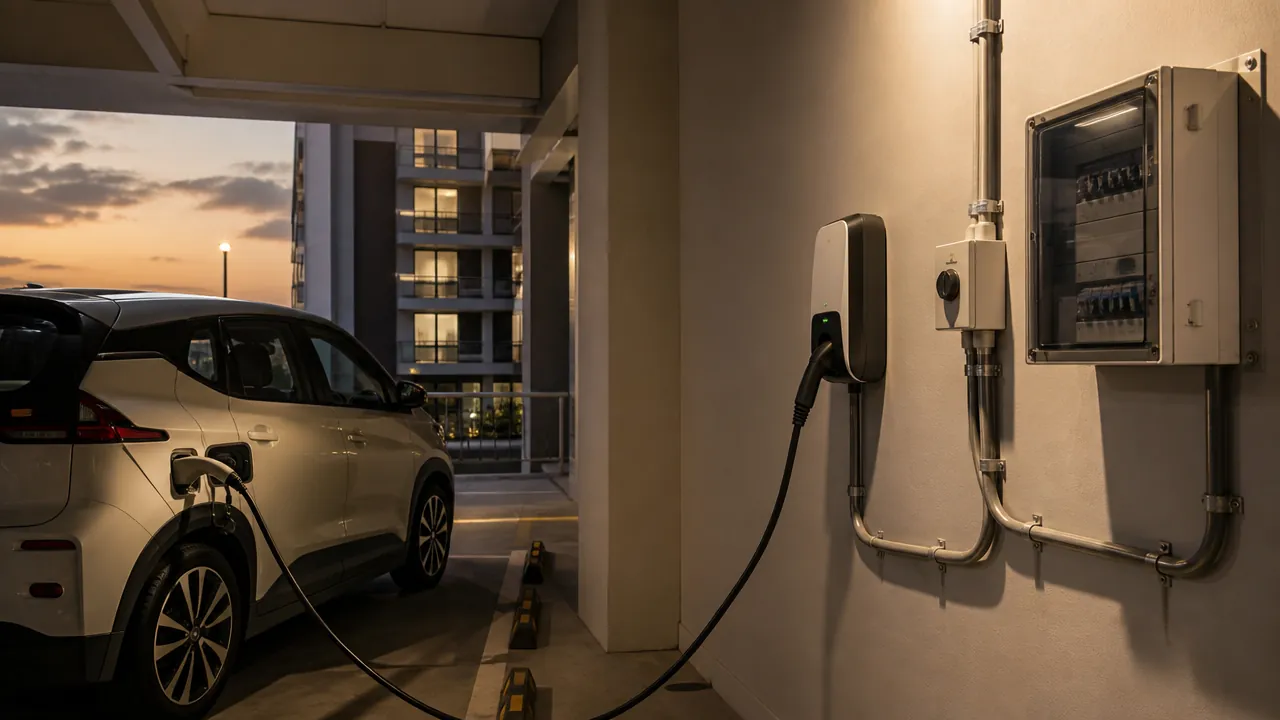
Installing an EV Charger at Home in India: Costs, Apartment Permissions and Safety Checks
The right home EV charger depends on more than charging speed. Your car’s onboard AC charging limit, household sanctioned load, parking location, cable distance, apartment permissions and electrical protection all affect the practical setup.
Use this guide to choose a charger, estimate the budget and complete the checks before starting home EV charging in India.
Choose the Right Home EV Charging Setup for Your Car and Electrical Supply
Portable 15A chargers, 3.3–3.6 kW wallboxes and 7.2–7.4 kW chargers compared
Your main options are:
- Portable 15A charger: Usually around 2.2–3.3 kW. It can work with a suitable socket, but the circuit must be correctly rated and independently protected. It is convenient for independent houses or occasional charging.
- 3.3–3.6 kW AC wallbox: A more permanent option for apartments and homes with limited electrical capacity. It can provide predictable overnight charging without demanding as much load as a 7.4 kW unit.
- 7.2–7.4 kW AC wallbox: Faster AC charging, generally requiring suitable wiring, protection and available sanctioned load. A single-phase supply may be sufficient in some installations, but the electrician must verify the site.
- Higher-power three-phase charger: Relevant only where the vehicle supports that input and the property has suitable three-phase supply and capacity.
Actual charging speed may be lower than the charger’s rating. The vehicle’s onboard AC charger, supply type, voltage, cable length and household demand all matter.
Check your car’s onboard AC charging limit before paying for a faster charger
A 7.4 kW charger will not make a car charge at 7.4 kW if its onboard AC charger accepts only 3.3 kW. Check the vehicle manual or manufacturer specifications before buying equipment.
For example, a car with a 3.3 kW AC limit may be well served by a 3.3–3.6 kW wallbox. A faster unit could still be useful for a future vehicle, but it may not justify the additional installation cost today.
Why sanctioned load and appliance demand matter
Do not assume that a standard 3 kW or 5 kW domestic connection can run a 7.4 kW charger alongside air-conditioners, geysers, induction cookers and other appliances. Compare the charger’s demand with your sanctioned load and likely simultaneous usage.
Where capacity is limited, a 3.3 kW charger with load management may be more practical than a faster unit. Load management can reduce charging power when household demand rises, but it does not replace proper electrical assessment.
How Much Does Home EV Charging Cost in India?
Indicative charger and installation costs by setup
The following are market estimates, not government-set prices:
| Setup | Indicative cost |
|---|---|
| Basic portable charger setup | ₹8,000–₹20,000 |
| 3.3–3.6 kW wallbox | ₹15,000–₹35,000 |
| 7.2–7.4 kW wallbox | ₹35,000–₹60,000 |
| Dedicated wiring, protection and installation | ₹10,000–₹30,000 |
A straightforward independent-house installation may cost roughly ₹20,000–₹60,000 overall. An apartment installation using a 7.4 kW wallbox can cost approximately ₹50,000–₹1.2 lakh or more, particularly when the cable route is long or civil work and a new connection are required.
Why apartment installations can cost ₹50,000–₹1.2 lakh or more
The charger is only one part of the project. Costs can increase when the parking bay is far from the meter, cables must pass through common areas, or the installation needs fire-rated conduit, trenching, drilling, additional distribution equipment or a separate meter.
A society may also require an approved contractor, inspection, restoration of walls or ceilings, and documentation before allowing the circuit to be energised.
The biggest cost drivers
Ask the installer to identify these items separately in the quotation:
- Cable length and size from the meter or distribution board to the parking bay
- Single-phase or three-phase supply requirements
- Circuit breaker, residual-current protection, isolator and surge protection
- Earthing improvements, if required
- Conduit, trunking, trenching and civil repairs
- Metering, load enhancement or a new DISCOM connection
- Society-approved installation and inspection charges
Apartment EV Charger Permission: What to Get from Your RWA or Society
Obtain written approval from the RWA, apartment association or facility manager before purchasing equipment or routing a cable through shared property.
Include these details in your request
Provide:
- Your flat number and registered parking details
- Vehicle make, model and registration information, where required
- Proposed charger type and rated output
- Meter location and the proposed cable route
- Installer or contractor details
- Cable, protection and earthing specifications
- Expected electricity consumption and billing method
- Responsibility for maintenance, damage, removal and future modification
Ask the association to confirm whether the charger can connect to your existing meter, whether a separate EV meter is required, and who will inspect the completed work.
Agree on billing and maintenance responsibility
The written approval should clarify who pays for electricity, meter installation, cable damage, periodic inspection and removal if you move house or change parking spaces. It should also state whether the charger remains your property and whether access is needed for future maintenance.
Extra checks for basement parking
Basement installations need additional attention. Confirm that the cable route does not obstruct fire exits, driveways, drainage channels or emergency equipment. Keep the charger away from standing water and possible vehicle impact. Do not route cables loosely across walking or driving paths.
If the parking area uses a common transformer or internal distribution system, ask the facility manager and a qualified electrician to confirm how the charger can be connected safely.
Existing Connection or Separate EV Meter? When to Contact the DISCOM
Under Ministry of Power guidance, a residential EV owner may use an existing electricity connection or apply to the local DISCOM for a separate metered connection for EV charging, subject to the applicable process and site conditions.
Using your existing residential connection
This may be the simplest option when the meter, sanctioned load and cable route can support the charger. The charger should still have a dedicated, correctly protected circuit rather than relying on an overloaded general-purpose socket.
When a separate EV connection may be needed
Contact the DISCOM when:
- The charger could exceed your sanctioned load
- You want a separate EV meter or tariff arrangement
- A new connection is needed near a parking or basement area
- Wiring would be connected before the domestic meter
- The apartment uses a common transformer or private internal distribution
- The association requires a formal utility connection
Do not energise a new circuit through an informal connection. Confirm the arrangement with the DISCOM, RWA and qualified installer first.
Home EV Charger Safety Checklist Before Installation
Before work begins, verify that:
- The sanctioned load and expected household demand have been checked
- A qualified electrician has inspected the supply and route
- The charger has dedicated, correctly rated wiring
- Isolation and appropriate circuit protection are installed
- Earthing has been tested and confirmed
- Cables are protected in approved conduit or trunking
- The route through common areas has written approval
- The charger is protected from water, impact and obstruction
- The parking bay remains accessible and safe for other residents
At handover, confirm the charger’s rated output and vehicle compatibility. Test charging under realistic household load, operate the protective devices, label the circuit and record the installation details.
Collect the invoice, warranty, commissioning record, protection specifications and installer contact details. Document who is responsible for future maintenance.
A Practical Decision Flow for Installing an EV Charger at Home
- Estimate your daily driving energy and the charging time available overnight.
- Check the car’s onboard AC charging limit.
- Choose a portable charger, 3.3–3.6 kW wallbox or 7.2–7.4 kW unit.
- Verify sanctioned load, supply type and simultaneous household demand.
- Obtain written RWA or society approval if you live in an apartment.
- Confirm the meter, cable route, protection and billing arrangement.
- Consult the DISCOM if load enhancement, separate metering or a new connection is required.
- Compare a site-specific quotation from a qualified installer.
- Complete wiring, earthing, access and water-protection checks.
- Test and document the installation before regular charging.
Planning home EV charging? Confirm your car’s AC input, sanctioned load, cable route and apartment permissions before purchasing equipment. The safest low-cost option is the one that matches your actual electrical capacity—not necessarily the charger with the highest rating.