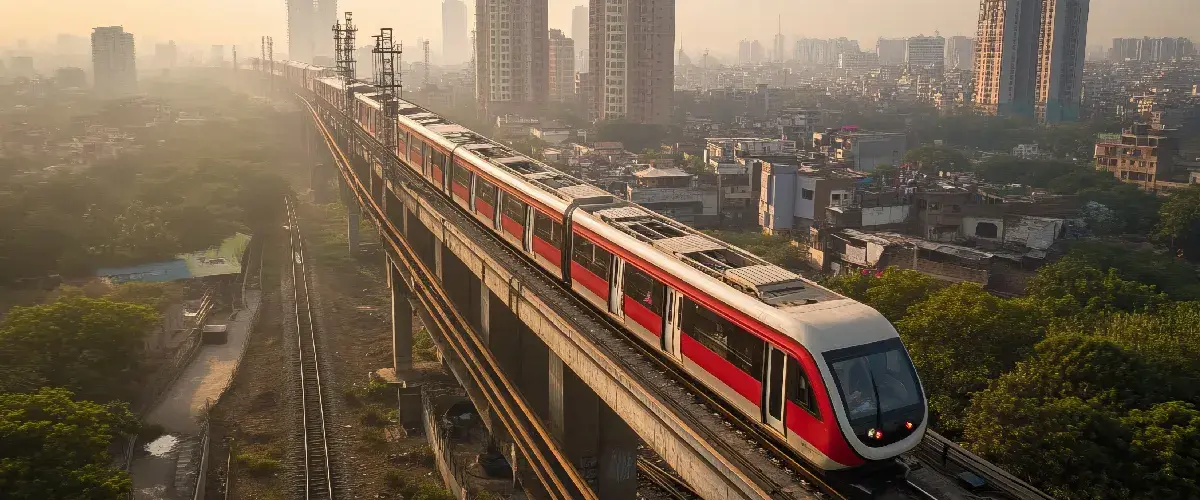
Andheri West has always been one of Mumbai's most liveable neighbourhoods. Its coastal proximity, vibrant social scene, strong social infrastructure, and position along the Western Railway line gave it a natural residential appeal that sustained demand through multiple real estate cycles. But something has shifted meaningfully in recent years — and the catalyst is the metro.
Infrastructure of this scale does not simply improve travel times. It redraws the mental map of a city, changing how residents think about distance, accessibility, and where they want to anchor their lives. In Andheri West, the metro's impact has been precisely this transformative — accelerating trends that were already underway, attracting a new tier of buyer and developer interest, and creating the conditions for sustained premium residential demand that will compound over the coming decade.
For buyers evaluating Andheri West today, understanding the metro's full implications — beyond the obvious commuting benefits — is essential to making a well-informed decision. The neighbourhood is in the middle of a structural upgrade, and the window to enter ahead of full re-rating is still open.
The rise of metro connectivity in Andheri West
Mumbai's metro network has expanded significantly, and Andheri West sits at one of its most strategically important nodes. Metro Line 1, connecting Versova to Ghatkopar via Andheri, was the city's first operational metro line and immediately demonstrated the transformative potential of rapid transit in a city previously dependent on overcrowded suburban rail and gridlocked roads. Travel times that once stretched to forty-five minutes or more in peak traffic collapsed to predictable, air-conditioned journeys of fifteen to twenty minutes.
The subsequent expansion of the metro network has deepened this advantage. Connections to the western suburbs, the airport corridor, and the broader city have made Andheri West increasingly multi-directional in its accessibility — a quality that is rare in Mumbai and that directly translates into residential desirability. Professionals working in BKC, Lower Parel, Goregaon, or Malad can all consider Andheri West as a realistic base, expanding the neighbourhood's effective catchment of potential residents considerably.
Importantly, the metro network serving Andheri West is still expanding. Planned extensions and new line completions will continue to strengthen the neighbourhood's connectivity profile over the next several years — which means the infrastructure premium being priced into Andheri West today is not the ceiling, but a point on an upward trajectory. Buyers entering the market now are purchasing ahead of the full benefit being delivered and priced in.
Growing demand for apartments in Andheri West
The most immediate and measurable consequence of improved metro connectivity has been a sustained increase in residential demand across Andheri West. Buyers who previously considered the neighbourhood primarily for its social infrastructure and Western Railway access are now factoring in metro convenience as a primary driver — and the combination of the two is proving exceptionally compelling for a broad cross-section of the market.
Families with children in reputed local schools, professionals with variable workplace locations, and couples who value walkability and urban energy have all identified Andheri West as a neighbourhood that serves their lives well. The area's established social ecosystem — international schools, multi-specialty hospitals, fitness studios, restaurants, and retail destinations ranging from neighbourhood markets to premium malls — provides the daily infrastructure that busy urban households depend on, without requiring residents to travel significant distances for essential services.
The rental market in Andheri West has tightened considerably as metro connectivity has improved. High-income professionals increasingly prefer the predictability and comfort of metro commuting over the anxiety of road travel, and they are willing to pay a premium for homes that offer genuine metro proximity. For investors, this rental demand dynamic translates into strong yields and low vacancy rates — the combination that underpins reliable income generation from residential assets.
Increased interest in 4 BHK flats in Andheri West
One of the most significant demand shifts in Andheri West over the past several years has been the growth in appetite for larger residential configurations. Four-bedroom apartments, which once represented a small and specialised segment of the local market, have become an active focus of developer planning and buyer interest. The metro is central to understanding why this shift has occurred.
Before reliable metro connectivity, families seeking spacious homes in Mumbai often concluded that they needed to trade central location for space — moving to larger but more distant suburbs where land costs allowed bigger floor plates at manageable prices. Metro access has fundamentally changed this equation. With fast, predictable transit available, the time cost of living in a well-connected urban neighbourhood like Andheri West has dropped to the point where families no longer feel compelled to accept peripheral locations in exchange for space.
Senior executives, entrepreneurs, and NRI buyers have been particularly active in the 4 BHK segment in Andheri West. For this demographic, the neighbourhood offers a combination that is genuinely difficult to find elsewhere in Mumbai: a prestigious, well-serviced urban address with the space and amenity quality associated with premium residential living, supported by transit infrastructure that makes the rest of the city accessible without the frustrations of road travel. Premium developers have responded to this demand with projects specifically designed to serve this buyer profile, and the quality of 4 BHK product available in Andheri West today is among the strongest in the city.
Property appreciation around metro corridors
The relationship between metro connectivity and residential property appreciation is well documented globally. Cities from London to Singapore to Hong Kong have demonstrated that properties within walking distance of metro stations consistently outperform the broader market over medium and long holding periods — and Mumbai is following the same pattern with increasing clarity as its metro network matures.
In Andheri West, the appreciation dynamic is particularly interesting because the neighbourhood was already a strong market before the metro enhanced its credentials. The infrastructure upgrade has not created demand from scratch — it has amplified existing strengths and attracted a higher tier of buyer and developer than was previously active in the area. This amplification effect tends to produce more sustained and reliable appreciation than infrastructure-driven demand in previously overlooked locations, because it is built on a foundation of genuine liveability rather than purely on a connectivity narrative.
Capital values in premium Andheri West developments have risen steadily, and the rental yield story has strengthened in parallel. Investors who purchased in quality buildings near metro stations several years ago have seen both asset appreciation and rental income growth — the dual return profile that represents the strongest possible case for residential real estate investment. As the metro network continues to expand and embed itself in the daily habits of Mumbai's professional class, the appreciation case for well-located Andheri West assets only strengthens.
Lifestyle advantages beyond connectivity
The metro's impact on daily life in Andheri West extends well beyond the obvious reduction in commute time. The psychological effect of reliable, comfortable transit on residents' relationship with their neighbourhood and their city is significant and often underappreciated. When commuting becomes predictable and low-stress, residents reclaim time and mental energy that previously went into navigating traffic — and they tend to invest that reclaimed resource into their local neighbourhood, deepening their connection to it and increasing their satisfaction with their home environment.
The result is a neighbourhood with stronger community cohesion, more active local retail and dining, and a higher baseline of resident investment in the quality of shared public spaces. These dynamics are self-reinforcing: as the neighbourhood becomes more pleasant to live in, it attracts more residents who value that quality, which further drives investment in the local environment. Andheri West is exhibiting exactly this pattern, with a noticeable improvement in the quality of its street-level experience that tracks closely with the metro's impact on commuting stress.
Work-life balance, access to recreational spaces, reduced travel fatigue, and the efficiency of a well-organised daily routine are all quality-of-life benefits that metro residents in Andheri West cite consistently. For premium buyers who are making a long-term decision about where to anchor their lives, these benefits compound over time in ways that make the premium associated with metro-adjacent premium housing genuinely justified — not just at purchase, but across the full ownership experience.
Role of developers in elevating the micro-market
Developer response to Andheri West's improving fundamentals has been rapid and increasingly ambitious. Leading Mumbai developers who previously focused their premium product on Bandra, Worli, or South Mumbai have established a meaningful presence in Andheri West, recognising that the neighbourhood's combination of connectivity, social infrastructure, and buyer profile supports premium pricing and strong absorption.
The quality bar for new residential launches in Andheri West has risen considerably. Projects now routinely offer amenity packages — rooftop pools, fully equipped gymnasiums, co-working lounges, children's activity centres, concierge services, and smart home integration — that were previously associated exclusively with Mumbai's most expensive postcodes. The physical quality of construction, the thoughtfulness of layout design, and the attention to common area finish have all improved materially as developers compete for a buyer who has high expectations and the means to act on them.
This developer quality upgrade is significant for investors because it signals confidence in the long-term trajectory of the micro-market. Developers commit capital to premium product only where they are confident in sustained demand and pricing support. The volume and quality of premium launches in Andheri West in recent years is therefore itself a form of market intelligence — experienced operators with extensive local knowledge are voting with their development pipelines that this is a neighbourhood worth backing at scale.
The NRI and investor perspective
Andheri West has long been a favoured destination for NRI buyers, drawn by its proximity to the international airport, its cosmopolitan social environment, and the cultural familiarity that the neighbourhood offers to diaspora buyers returning to Mumbai. Metro connectivity has strengthened this appeal by making the neighbourhood even more accessible to the globally mobile buyers who value the ability to reach the airport and the city's key destinations without planning around traffic.
For NRI investors specifically, Andheri West offers a rental yield profile that is among the most reliable in Mumbai. The neighbourhood's tenant base — predominantly high-income professionals, senior executives, and expatriates — is financially stable, tends toward longer lease terms, and is consistently present in the market regardless of broader economic conditions. This tenant quality translates into predictable income, low turnover costs, and the kind of landlord experience that makes property investment genuinely passive rather than operationally demanding.
The capital appreciation case for NRI investors is equally strong. Mumbai's premium residential market has delivered consistent long-term appreciation, and Andheri West's specific combination of improving infrastructure, rising product quality, and broadening buyer demand positions it well for continued outperformance. For NRI buyers evaluating where in Mumbai to invest, the neighbourhood's credentials — connectivity, social infrastructure, developer quality, and appreciation track record — make a compelling case that is only strengthening as the metro network continues to expand.
Summary
Metro connectivity has not simply improved commuting in Andheri West — it has triggered a fundamental reassessment of the neighbourhood's value among buyers, investors, and developers. The impacts are visible across every segment of the residential market: stronger demand for apartments at all configurations, rising appetite for premium 4 BHK homes from senior buyers who no longer need to trade location for space, sustained capital appreciation in metro-adjacent developments, and a rising quality of developer product that reflects genuine confidence in the neighbourhood's long-term trajectory.
For buyers considering Andheri West today, the fundamental case is clear and well-supported. The neighbourhood offers a combination of liveability, connectivity, social infrastructure, and investment credentials that is difficult to match anywhere else in Mumbai at comparable price points. As the metro network continues to mature and its benefits compound further into the neighbourhood's daily life and property values, the decision to invest in Andheri West will look increasingly well-timed in retrospect.