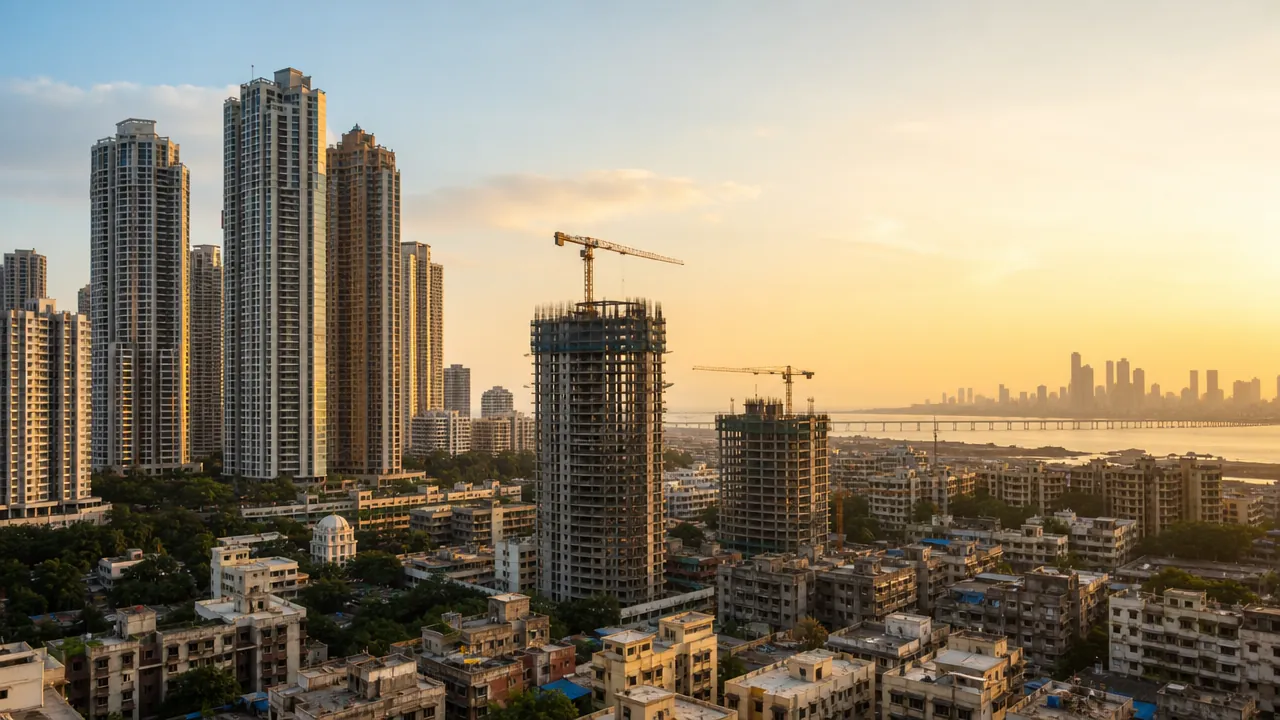
India Home Prices Have Outpaced Construction Costs: What Mumbai Buyers Should Know
India’s home prices have risen much faster than construction costs in recent years. For Mumbai buyers, that gap is a useful reminder: the price of a home is shaped by far more than cement, steel and labour.
Between 2021 and 2025, home prices across India’s seven largest cities reportedly increased by about 59%, while construction costs rose by approximately 34%. Standard-plus construction costs also moved from around ₹2,681 per sq. ft. to ₹3,604 per sq. ft. during the same period.
That does not mean construction costs are unimportant. They affect project budgets, replacement costs and developer pricing. However, Mumbai property prices also reflect scarce land, location, development rights, approvals, financing, amenities, demand and execution risk.
Quick summary: A Mumbai home is priced not only for the structure built on the plot, but also for the land beneath it, the rights attached to it and the future value of its location.
Home prices rose 59% while construction costs rose 34% between 2021 and 2025
The difference between these two growth rates is central to understanding India’s residential property prices. If construction costs had been the only major driver, home prices would generally be expected to move more closely with building expenses. Instead, market prices increased substantially faster.
Standard-plus construction costs increased from about ₹2,681 to ₹3,604 per sq. ft.
Construction costs include expenses such as structural work, finishing, labour and materials. Standard-plus costs reportedly increased from approximately ₹2,681 per sq. ft. in 2021 to ₹3,604 per sq. ft. in 2025.
This rise can affect the cost of new launches and the amount developers need to spend to complete existing projects. It can also influence the replacement value of an older building. But construction cost is only one component of a home’s eventual selling price.
Construction inflation explains only part of the increase
The final price may also include:
- The value of the underlying land
- Development rights and permissible floor area
- Location and access to employment centres
- Transport infrastructure and neighbourhood improvements
- Developer margins and financing costs
- Approval, compliance and marketing expenses
- Construction delays and execution risk
- Demand relative to available supply
This is why a home can become more expensive even when the cost of building its physical structure does not rise at the same pace.
Why Mumbai property prices can rise faster than building costs
Mumbai is a clear example of a market where land economics often matter more than construction inflation alone.
Scarce land creates a premium that construction costs cannot capture
In a land-constrained city, the plot can represent a significant share of the total value. Two buildings with similar specifications may command very different prices because they sit on land with different access, development potential and scarcity value.
A rise in cement or labour costs affects the cost of constructing a building. A rise in land value affects every apartment that can legally and economically be developed on that land.
This distinction is important for buyers. Lower steel or cement prices may reduce project pressure, but they do not automatically reduce the value of a well-located plot.
Location, jobs and transport access support higher Mumbai real estate prices
Mumbai homes are also priced for access. Proximity to offices, business districts, schools, healthcare, retail areas and transport connections can support a premium even when the construction specification is similar to that of a project elsewhere.
New or improved transport links can change how buyers assess a neighbourhood. However, buyers should distinguish between an operational benefit and a promise that has not yet materialised. A planned infrastructure project should not be valued in the same way as an existing connection.
FSI, redevelopment rights and approvals affect the value of each project
Mumbai’s redevelopment projects often involve complex calculations involving Floor Space Index, or FSI, transferable development rights, rehabilitation obligations, consent arrangements and approval timelines.
A project with greater development potential may support a higher land value. Conversely, unresolved title issues, incomplete permissions or complicated society arrangements can increase risk and financing costs.
The same quoted price per sq. ft. can therefore represent very different economics in a new construction project and a redevelopment project. Buyers should understand what development rights have been assumed and whether the project’s approvals support the promised configuration.
Financing costs, developer margins and execution risk enter the final price
Developers must fund land, design, approvals, construction, sales and overheads. Interest expenses can rise when projects take longer than expected or when borrowing costs increase. These expenses may be reflected in the launch price.
A higher price does not necessarily indicate excessive profit, just as a lower price does not automatically indicate value. Buyers need to assess what the price is paying for and whether the project can be delivered within its stated timeline.
What construction costs do—and do not—tell Mumbai homebuyers
Construction-cost data is useful, but it should be interpreted correctly.
Replacement cost is different from the market price of a completed home
Replacement cost answers a question such as: How much might it cost to construct a similar building today? Market price answers a broader question: What are buyers willing to pay for this home, in this location, with these rights, amenities and risks?
The two figures can diverge. An older building may have relatively modest construction value but sit on land with substantial redevelopment potential. A new building may have high construction costs but limited resale appeal if it is poorly connected or difficult to access.
Mumbai MEP costs are rising but do not explain the full price gap
Mechanical, electrical and plumbing costs in Mumbai reportedly rose by about 19.6% between 2023 and 2025. These systems are essential to modern buildings and can materially affect project budgets, particularly in taller or more amenity-rich developments.
Even so, MEP inflation does not explain the full gap between the increase in apartment prices and the increase in construction costs. It is one pressure within a much larger pricing system.
Lower cement or steel prices may not make homes materially cheaper
Waiting for a moderation in material prices may not lead to a proportionate fall in Mumbai home prices. If land values, location premiums, financing expenses and demand remain elevated, the market price may remain firm.
This does not mean buyers should rush into a purchase. It means that a decision based only on an expected fall in construction costs may overlook the factors that have the greatest influence on the specific project being considered.
The price per square foot is not enough to compare Mumbai projects
Per-square-foot pricing is a useful starting point, not a complete valuation method.
Check carpet area, land allocation and FSI utilisation
Compare homes using the same area definition, preferably RERA carpet area. A quoted rate based on carpet area cannot be compared directly with one based on a larger built-up or saleable area.
Also ask:
- How much land value is allocated to the project?
- What FSI has been used, and what remains available?
- Is the project part of a redevelopment arrangement?
- Are rehabilitation or other obligations affecting the buildable area?
- Are promised amenities included in the stated price?
For example, a 900 sq. ft. carpet-area apartment quoted at ₹30,000 per sq. ft. has a base price of ₹2.7 crore before additional charges. A smaller apartment at a lower rate may still have a higher effective cost per usable room if its layout, storage and natural light are weaker.
Account for parking, floor-rise charges and preferred-location premiums
The headline rate may exclude or separately identify:
- Parking
- Floor-rise charges
- Preferred-location charges
- Clubhouse or amenity fees
- Infrastructure or utility charges
- Legal and documentation expenses
- Maintenance deposits
Request a written cost sheet and ask whether each item is mandatory, optional or subject to change.
Compare redevelopment structures and delivery risks before choosing a project
A redevelopment project may offer a central location and attractive land economics, but it can also involve approval, consent and execution risks. A conventional new-build project may have a clearer structure while carrying different risks, such as phased construction or delayed infrastructure.
The right comparison is not simply “old building versus new building.” It is the total value, risk and timing attached to each project.
Calculate the all-in cost of buying a home in Mumbai
The base price is rarely the amount that leaves your bank account. Estimate the all-in cost before making a booking decision.
Add GST, stamp duty and registration to the base price
Depending on the property type and construction stage, applicable GST may be payable. Stamp duty and registration charges also need to be budgeted for in Maharashtra. The exact treatment can vary, so buyers should confirm the current rules and obtain a project-specific calculation before signing.
Include parking, amenities, infrastructure fees and maintenance deposits
A practical cost sheet should include the base apartment price plus all project-related charges. These may include parking, amenities, infrastructure, electricity or water connection charges and an advance maintenance deposit.
For a home with a ₹2.7 crore base price, even charges that appear small as percentages can add several lakhs. Treating them as an afterthought can lead to an avoidable funding shortfall.
Budget for brokerage, legal review and other transaction expenses
Buyers should also account for brokerage, legal review, loan-processing charges, valuation fees, moving expenses, interiors and initial furnishing. These costs may not appear on the developer’s demand schedule but still affect the purchase decision.
A simple formula is:
All-in cost = base price + taxes and government charges + project charges + financing costs + professional fees + setup expenses
How rising India home prices affect Mumbai affordability
A slower rate of annual price growth does not automatically make homes affordable. If prices have already moved ahead of household income and savings, affordability may remain stretched even after appreciation moderates.
Measure the EMI against stable take-home income
Base your calculation on stable monthly income, not a bonus, uncertain commission or expected salary increase. Include existing loans, school fees, insurance, investments and regular household costs before deciding what EMI is comfortable.
A buyer who can technically qualify for a larger loan may still face financial stress if the EMI leaves little room for emergencies or future expenses.
Stress-test the loan for higher rates, delays and unexpected costs
Run at least three scenarios:
- The expected interest rate and possession timeline
- A higher interest rate or reduced household income
- A construction delay combined with rent and pre-EMI obligations
For an under-construction home, consider the possibility of paying rent while servicing loan-related costs. Keep a separate contingency reserve for interiors, registration, moving and delayed possession.
Recognise that slower price growth does not automatically restore affordability
The decline in affordable and lower-ticket housing supply in major cities suggests that new launches are increasingly concentrated in upper-middle-income and premium segments. Buyers may therefore need to compare more locations, consider a smaller but better-connected home, or evaluate a ready property against an under-construction option.
A practical checklist for buying in Mumbai’s housing market in 2026
Before committing to a Mumbai home, use this framework:
1. Compare locality-level prices
Compare similar carpet-area homes in the same micro-market. Adjust for building age, floor, condition, parking, access, amenities and possession status.
2. Verify area and specifications
Confirm the carpet area, layout, balcony treatment, parking entitlement and promised specifications in writing. Do not rely only on a brochure or verbal assurance.
3. Check title, approvals and MahaRERA registration
Review the title documents, sanctioned plans, commencement permissions, project disclosures and applicable approvals. Check the project’s MahaRERA registration and compare the developer’s claims with the registered information.
4. Assess construction-stage and developer risk
Review the developer’s delivery history, current construction progress, funding position and record on quality and defect resolution. A lower launch price may not compensate for a long delay.
5. Calculate the complete ownership cost
Obtain a written cost sheet covering taxes, duties, parking, floor-rise charges, amenities, maintenance deposits, brokerage, legal fees, loan costs and interiors.
6. Evaluate resale demand and exit liquidity
Ask who is likely to buy the home from you in the future. A property with a large buyer pool, practical layout and reliable connectivity may be easier to resell than one priced mainly on a speculative future promise.
The key takeaway for Mumbai buyers
India’s home prices have outpaced construction costs because a home is more than a physical structure. In Mumbai, land scarcity, development rights, location, access, financing and project risk can matter as much as—or more than—the cost of materials and labour.
Construction-cost inflation remains relevant, but it should not be used as a shortcut for valuing a property. The better approach is to examine the land and rights behind the project, verify the carpet area and approvals, calculate the all-in acquisition cost, and test the EMI against realistic household finances.
Before booking, compare projects on total cost, usable space, delivery risk and resale demand—not on the headline ₹ per sq. ft. alone.
Frequently asked questions
Why are India home prices rising faster than construction costs?
Construction costs are only one component of a home’s price. Land values, location premiums, development rights, financing expenses, developer margins, amenities, infrastructure and demand-supply conditions can push prices higher than construction-cost inflation.
Does a fall in cement or steel prices mean Mumbai homes will become cheaper?
Not necessarily. Material costs may moderate while land values, financing costs and location premiums remain high. The effect on the final home price depends on the project’s complete economics.
What matters more in Mumbai: construction cost or land value?
Both matter, but land value can be especially influential in established and well-connected areas where developable land is scarce. Development potential, FSI and redevelopment rights can further increase the value associated with a plot.
How should I compare two Mumbai projects with different per-square-foot rates?
Compare carpet area, total all-in cost, location, parking, amenities, floor-rise charges, FSI utilisation, construction quality, possession timeline and resale potential. A lower quoted rate may not represent a lower cost or better value.
What should be included in the all-in cost of a Mumbai home?
Include the base price, applicable GST, stamp duty, registration, parking, floor-rise and preferred-location charges, amenities or infrastructure fees, maintenance deposits, brokerage, legal fees, loan-related costs, interiors and moving expenses.
How can I test whether a Mumbai home is affordable?
Calculate the EMI using stable take-home income, include existing obligations and test the loan against higher interest rates, income disruption and possession delays. Maintain an emergency reserve rather than using every available saving for the down payment.
Should I buy now or wait for construction costs to fall?
That depends on your finances, time horizon and property choice. Waiting solely for construction costs to decline may not work if land and location premiums remain firm. Buy only after verifying the project, understanding the all-in cost and confirming that the EMI is sustainable.
What is the most important due-diligence step before booking?
No single check is sufficient. Verify the title, approvals, registered project details, carpet area, payment schedule, construction progress, developer history and complete cost sheet before signing or paying a substantial amount.