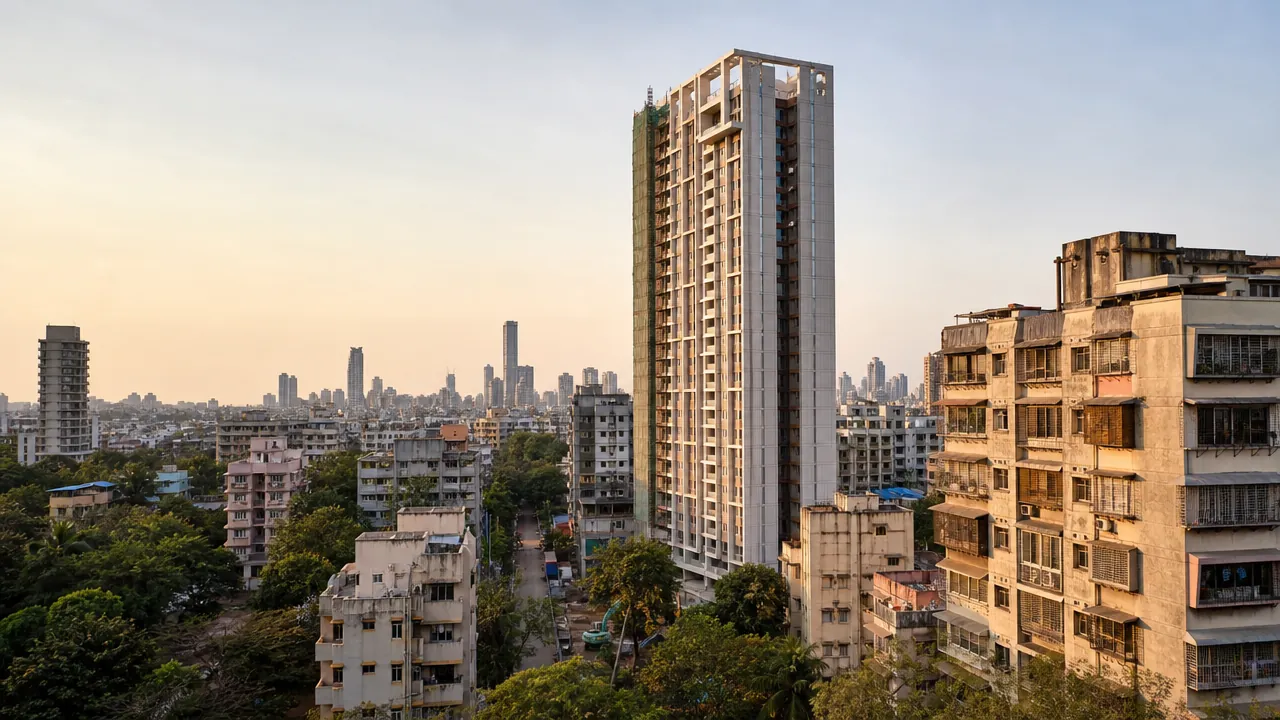
Mumbai Redevelopment Market Enters a New Phase as Redevelopment Sales Reportedly Outpace New Launches
Meta description: Explore how Mumbai redevelopment projects are reshaping housing supply, why western suburbs are attracting activity, and the risks buyers, residents and investors should assess.
Mumbai’s redevelopment market appears to be moving beyond its traditional role as a solution for ageing housing societies. It is increasingly being discussed as a mainstream source of new homes in established neighbourhoods—particularly at a time when vacant land is scarce and demand remains concentrated in well-connected locations.
Reports published during 2025 and the first half of 2026 describe a potential turning point: housing sales associated with redevelopment projects reportedly exceeded sales from newly launched projects during the period. Other reported figures suggest that redevelopment projects represented about 15% of Mumbai housing sales, compared with approximately 6% during 2016–2021, and that more than 1,000 projects have launched since 2020.
These numbers are significant if confirmed. However, they should be treated as reported estimates rather than independently verified market-wide statistics. The published reports do not provide enough detail to establish the complete dataset, geographic coverage, project sample, or the exact comparison between redevelopment and greenfield launches. That distinction matters when using the figures to make property or investment decisions.
Mumbai redevelopment projects are becoming a major source of new housing
Redevelopment projects now account for a larger reported share of housing sales
The central claim is that sales from redevelopment-led housing projects overtook sales from newly launched projects in 2025 and the first half of 2026. This is not the same as saying that all redevelopment homes sold more quickly, or that redevelopment replaced new construction across every locality.
The comparison may instead reflect the changing composition of Mumbai’s supply. If fewer large parcels are available for greenfield development, while multiple redevelopment projects are launched across established neighbourhoods, the cumulative number of homes sold through redevelopment can become substantial even when individual projects are relatively small.
The reported share of approximately 15% also requires careful interpretation. The reports do not clearly define whether “housing sales” means:
- Registered transactions or developer-reported bookings;
- Units sold during a specific quarter, calendar year or rolling period;
- Sales in the Mumbai municipal region, the wider Mumbai Metropolitan Region or another geography; or
- Homes sold in projects formally classified as redevelopment, including society redevelopment, cluster redevelopment and redevelopment of leased or government-owned land.
The earlier comparison of about 6% during 2016–2021 may also use a different sample or measurement period. Without a published table showing units sold, project categories, locations and time periods side by side, the 15% and 6% figures should be read as directional indicators rather than precise market shares.
More than 1,000 projects have reportedly launched since 2020
A separate reported estimate puts the number of redevelopment projects launched since 2020 at more than 1,000, representing roughly 13% of residential supply. Here too, the definitions are important.
“Projects launched” could mean projects formally marketed to buyers, projects that received a regulatory commencement approval, or projects announced by developers and housing societies. Likewise, “residential supply” could refer to total units launched during the period, the existing housing stock, or the inventory tracked by a particular research database.
The figures were reported by the Times of India and discussed in a report by Realty Aggregator. Neither the available summary nor the research material provides a full methodology explaining the database, project universe, geographic boundaries, or treatment of stalled and partially launched schemes. The reports also do not publish a direct numerical comparison showing, for the same geography and period, redevelopment sales versus sales from newly launched non-redevelopment projects.
The most responsible conclusion is therefore narrower: redevelopment has become materially more visible in Mumbai’s housing pipeline, and it may have reached a scale that deserves to be analysed alongside conventional new development. The precise milestone still requires confirmation through transparent, comparable data.
Why the Mumbai redevelopment market is expanding
Limited vacant land is pushing developers toward existing neighbourhoods
Greenfield development usually begins with a relatively large, clear parcel. In Mumbai, assembling such land can involve high acquisition costs, fragmented ownership, planning restrictions and long approval timelines. Redevelopment offers a different route: the developer works within an existing urban fabric and unlocks additional floor area through better planning, higher permissible density or redevelopment incentives, subject to applicable regulations.
This does not make redevelopment simpler. It changes the risk profile. Instead of negotiating primarily with landowners, a developer may have to coordinate with dozens or hundreds of residents, lenders, authorities and service providers. The land constraint makes redevelopment attractive, but the execution burden can be greater.
Ageing buildings are creating demand for safer, upgraded homes
Many older buildings face problems such as structural deterioration, inadequate lifts, outdated fire systems, water seepage, poor parking arrangements and inefficient layouts. A successful project can address several of these issues at once by replacing ageing structures with modern buildings and shared infrastructure.
For existing residents, the value proposition is not limited to a larger apartment. It may include improved safety, better accessibility, formalised common areas and more reliable building services. For buyers entering the new sale component, the attraction is often the location: they can purchase a newer home in a mature neighbourhood rather than move to a peripheral area.
Homebuyers continue to support demand for well-connected locations
Mumbai’s employment centres, schools, hospitals, retail districts and public transport networks are unevenly distributed. Established areas can therefore command demand even when their buildings are old. Redevelopment converts that demand into new inventory without requiring buyers to abandon familiar social and commuting networks.
A simple example illustrates the difference. A buyer may compare a compact new apartment in an established suburb, within walking distance of rail or major roads, with a larger apartment in a distant greenfield corridor. The second option may offer more space, but the first may offer a shorter commute, established services and stronger resale liquidity. Redevelopment benefits when buyers place a high value on those location advantages.
Mumbai’s western suburbs remain a key redevelopment hotspot
Established suburbs combine housing demand with redevelopment potential
The western suburbs have several characteristics that support redevelopment activity: mature residential clusters, ageing cooperative housing societies, access to rail and road networks, and sustained demand from end users. However, the opportunity is not uniform across the entire belt.
A society close to a transport interchange may attract strong buyer interest but face expensive land, complex traffic and intense construction constraints. A building farther from the main corridor may have more manageable site logistics but a smaller pool of buyers. Older low-rise clusters may offer redevelopment potential, while already-dense neighbourhoods may be limited by plot shape, access roads, parking needs or applicable development controls.
This means that “western suburb redevelopment” should not be treated as a single investment category. The relevant questions are more local:
- How close is the site to existing and planned transport infrastructure?
- Can construction vehicles access the plot without disrupting surrounding buildings?
- Does the layout provide enough area for rehabilitation homes, sale inventory, parking and amenities?
- Are residents aligned on the redevelopment proposal?
- Is buyer demand strong enough at the likely selling price?
Infrastructure improvements could strengthen values in connected locations
New and improved transport infrastructure can increase the appeal of redevelopment sites by reducing travel time and improving access to employment and services. But infrastructure announcements alone do not guarantee price appreciation. The effect depends on completion, station or interchange proximity, last-mile access, noise and congestion impacts, and whether competing supply enters the same micro-market.
A practical approach is to distinguish between three stages of infrastructure impact:
- Announced: The project is publicly proposed but may face funding, land or approval uncertainty.
- Under construction: The route or facility is progressing, but the final benefit and completion date remain uncertain.
- Operational: Buyers can assess actual travel-time savings, accessibility and neighbourhood effects.
Redevelopment values should be assessed more conservatively at the first stage and with stronger evidence at the third.
What the shift means for Mumbai homebuyers and investors
Redevelopment is widening the supply of homes in established areas
If the reported trend continues, redevelopment can increase the availability of newer homes without moving all new supply to the urban edge. This may benefit buyers seeking modern construction, better amenities and established social infrastructure.
It can also create more choice within a locality. A buyer might compare a completed redevelopment project, an under-construction project and an older resale apartment. Each has a different balance of price, possession certainty, customisation, maintenance and legal risk.
Buyer due diligence should follow the project’s stage
A redevelopment project should not be evaluated only by its brochure, proposed amenities or expected possession date. The risk changes at each stage:
| Project stage | Main questions to ask |
|---|---|
| Society selection | Have residents formally appointed the developer? Is the appointment process documented? |
| Agreement and approvals | Are the development agreement, individual consent documents and power of attorney properly executed? |
| Planning and registration | Are required permissions and project registration details available and consistent? |
| Vacating and construction | Is temporary accommodation defined? Who pays rent, deposits and shifting costs? |
| Construction | Is there evidence of funding, contractor capability and regular progress? |
| Possession | Are occupancy permissions, promised specifications and society handover requirements complete? |
A buyer entering the sale component should also verify title and encumbrances, sanctioned plans, construction-linked payment terms, carpet area, parking rights, possession commitments, cancellation terms and the developer’s history of completed projects—not just announced projects.
Investors should distinguish redevelopment potential from guaranteed returns
An ageing building may appear to have redevelopment potential, but potential is not a return. Value depends on resident consent, buildable area, project economics, approvals, financing and the final sale price. A high-value location can still produce a weak project if construction costs or rehabilitation obligations consume the margin.
For example, an investor buying an older apartment in anticipation of redevelopment should model at least three outcomes:
- Base case: The project proceeds broadly on schedule and the investor receives the agreed benefit.
- Delay case: Consent, approval or financing issues extend the timeline and increase rent or holding costs.
- No-project case: Redevelopment does not proceed, leaving the investor with an ageing asset and uncertain resale demand.
This approach is more realistic than pricing the apartment as though redevelopment has already been approved and funded.
The main challenges facing redevelopment projects in Mumbai
Resident consent and negotiations can delay project timelines
A redevelopment proposal must balance the interests of residents with those of the developer. Differences may arise over carpet area, rent, corpus payments, parking, commercial rights, selecting the developer or the treatment of dissenting members.
A project can therefore remain commercially attractive but operationally stalled. Buyers should ask whether the required consents have been obtained, whether disputes are pending, and whether the society’s resolutions and agreements are available for review.
Regulatory approvals and project financing remain critical risks
Redevelopment involves multiple approvals and technical dependencies. Delays may arise from planning permissions, building proposals, environmental or fire-related clearances, title issues, utility arrangements or changes in applicable regulations.
Financing is equally important. The developer must fund construction, resident accommodation, approvals, labour, materials and other project costs before receiving all sale proceeds. A developer with a strong brand but weak project-level funding can still face delays. Evidence of financial closure, lender involvement and construction progress is more useful than reputation alone.
Temporary accommodation and construction delays affect residents
For existing occupants, the most immediate risk begins when they leave their homes. The agreement should clearly specify rent or alternate accommodation, escalation terms, payment frequency, deposit responsibility, shifting expenses and remedies for delay.
A delay of 12 months can have a material effect. If a resident receives monthly rent but local rental values rise faster than the agreed escalation, the gap becomes an out-of-pocket cost. Residents should understand that risk before signing, while buyers should recognise that resident disputes can affect the project’s schedule and financing.
What comes next for Mumbai’s residential real estate market
Redevelopment is likely to remain a core source of Mumbai housing supply
The structural reasons behind redevelopment are unlikely to disappear quickly: limited vacant land, ageing buildings, established transport corridors and buyer preference for accessible neighbourhoods. As a result, redevelopment should be analysed as a core supply channel rather than an occasional society-level solution.
The comparison with greenfield development is useful. Greenfield projects may offer clearer site control and a more predictable construction environment, but they can require new infrastructure and may be farther from established demand. Redevelopment can access stronger locations, but it carries heavier coordination, consent and rehabilitation obligations.
Execution quality will determine whether growth is sustainable
The reported statistics may indicate a genuine shift, but volume alone is not enough. A healthy redevelopment market should also show timely delivery, transparent agreements, financially viable projects and protection for displaced residents and buyers.
The next useful set of market data would show redevelopment and non-redevelopment projects on the same basis: units launched, units sold, sales value, project geography, project stage and delivery performance. Until that information is available, the reported milestone is best viewed as an important market signal rather than a definitive measurement.
Conclusion: Mumbai redevelopment is moving into the mainstream
Mumbai’s redevelopment market is becoming too large to treat as a narrow property-society issue. It is influencing the city’s housing supply, buyer choice and developer strategy, especially in established suburbs where land is scarce and demand remains resilient.
Reports of redevelopment sales overtaking new-launch sales are noteworthy, but the headline figures need clearer definitions and independent confirmation. For buyers, residents and investors, the practical lesson is straightforward: assess the project’s stage, documentation, funding, resident arrangements and delivery record before assigning value to its redevelopment potential.
Exploring a redevelopment opportunity in Mumbai? A qualified real estate adviser can help evaluate approvals, developer experience, financing, resident agreements and the expected delivery timeline before you make a decision.
Frequently asked questions
What is driving the Mumbai redevelopment market?
The main drivers are limited vacant land, ageing buildings, demand for safer and more modern homes, and buyer preference for established locations with transport and social infrastructure.
Did redevelopment housing sales definitely exceed new project launches?
The claim has been reported for 2025 and the first half of 2026, but the available reports do not provide enough data to independently verify it. They do not clearly disclose the geography, project sample, definition of sales or a direct like-for-like comparison between redevelopment and non-redevelopment launches.
What does the reported 15% share of housing sales mean?
It reportedly refers to the share of Mumbai housing sales associated with redevelopment projects. However, the available information does not clarify whether sales means registered transactions, bookings or another measure, nor does it fully define the geographic and time-period scope.
Are all redevelopment projects equally attractive to buyers?
No. Location, approvals, access, project design, resident arrangements, funding, developer experience and expected delivery can vary significantly. A completed project and a society that is still negotiating with developers should not be valued in the same way.
What should a buyer check before purchasing in a redevelopment project?
Check the project’s registration and approvals, title and encumbrances, sanctioned plans, development agreements, construction status, payment schedule, possession terms, parking rights, specifications, developer track record and provisions covering delay or cancellation.
Is redevelopment potential a reliable investment strategy?
It can create value, but it is not guaranteed. Investors should model delays, rising holding costs and the possibility that the project may not proceed. Redevelopment potential should be treated as one scenario in an investment analysis, not as a certainty.