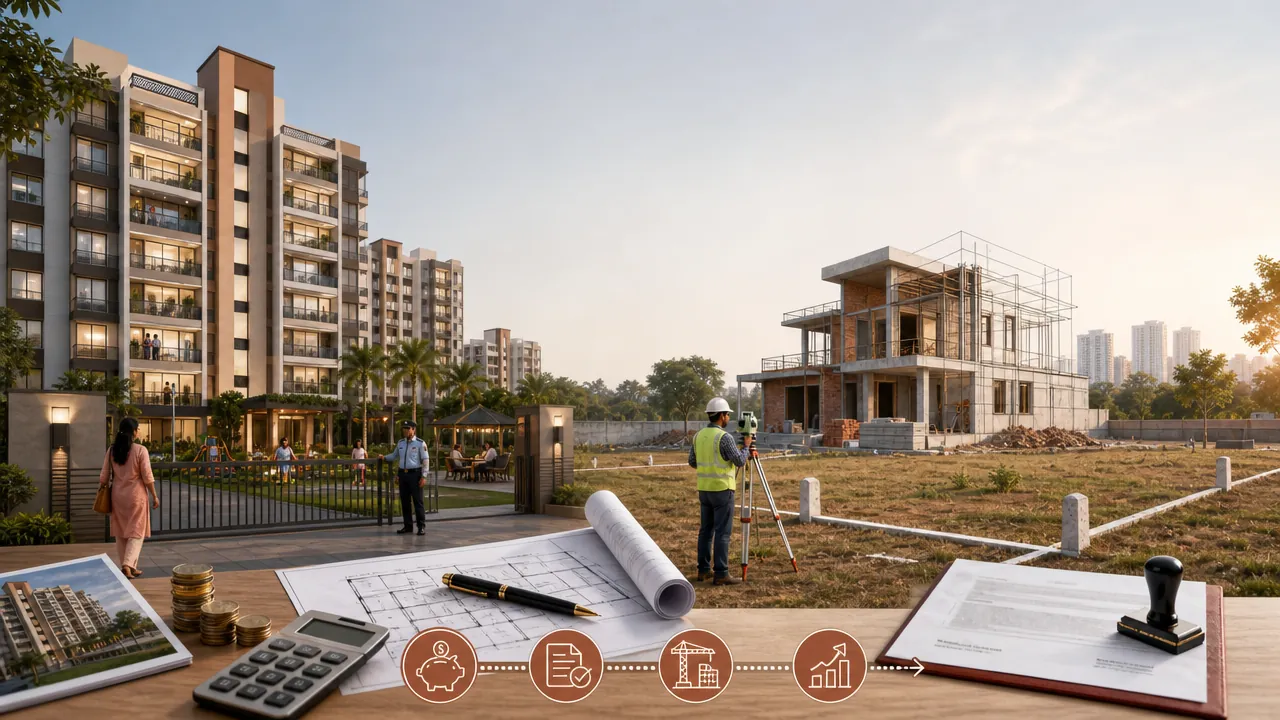
Plot or Apartment in India? A Practical Guide to Cost, Approvals and Long-Term Value
Choosing between a plot and an apartment is not simply a choice between land appreciation and rental income. It is a decision about how soon you need to use the property, how much execution risk you can manage, how you will finance it and what kind of exit you expect.
A plot may offer design freedom and direct land ownership, but it can involve title checks, layout approvals, construction planning and a longer wait before the property becomes usable. An apartment may offer faster occupancy and more predictable execution, but it includes shared maintenance costs, less customization and potential concerns about construction quality, possession or resale demand.
This guide explains plot vs apartment in India through total cost, approvals, financing, cash flow and long-term value. Stamp duty, registration, planning permissions, taxes and loan terms vary by state, city and local authority. Confirm the rules applicable to your property before committing funds.
The Right Choice Depends on How You Plan to Use the Property
Choose an apartment for faster occupancy and more predictable execution
An apartment may be more suitable if you:
- Need a home within a defined time frame.
- Prefer one consolidated purchase instead of managing construction.
- Want access to shared amenities, security and common services.
- Expect rental income from a location with established tenant demand.
- Prefer a home loan structure that covers the property and its construction more directly.
The main trade-off is limited control over the building, common areas and future maintenance decisions. You should also assess the developer’s delivery record, project approvals, maintenance structure and the quality of the local rental market.
Choose a plot for customization, phased construction and direct land ownership
A plot may fit you better if you:
- Want to design a home around your family’s needs.
- Can wait several years before constructing.
- Have the time or professional support to manage approvals and contractors.
- Prefer to hold land as a long-term asset.
- Want the option to construct in phases, subject to local rules and financing terms.
The trade-off is execution risk. A plot is not a ready-to-use home. The final cost depends on construction prices, approvals, site conditions, utility availability, contractor performance and the time value of money.
Simple rule: Choose an apartment for convenience and predictable use. Choose a plot when customization and long-term land ownership justify the additional work and uncertainty.
Plot vs Apartment in India: A Quick Comparison
| Factor | Plot | Apartment |
|---|---|---|
| Initial purchase | Land price plus transaction and verification costs | Base price plus project-specific and transaction charges |
| Usability | Requires design, approvals and construction | Usually usable after possession and required documentation |
| Customization | High, subject to building rules | Limited to interiors and permitted alterations |
| Timeline | Purchase and construction may be separated | More predictable, but depends on project completion |
| Ongoing costs | Lower before construction; site upkeep may still apply | Maintenance charges, sinking fund and repair contributions |
| Financing | Plot loans may have stricter conditions; construction finance may be separate | Home-loan products are often more structured, subject to lender eligibility |
| Rental income | Usually unavailable until construction is complete | Possible after possession in a tenant-friendly location |
| Legal risk | Title, land use, layout, access and boundary risks | Project, title, approval, construction and possession risks |
| Liquidity | Depends heavily on location and documentation | Depends on demand, building age, maintenance and project reputation |
| Long-term value | Driven by land scarcity, infrastructure and demand | Driven by location, usability, rental demand, building quality and age |
Neither property type automatically produces better returns. A well-located apartment with reliable rental demand may outperform a poorly documented plot. A legally clean plot in a growing corridor may outperform an ageing apartment in a saturated market.
How Much Does Buying a Plot Really Cost?
The advertised land price is only the starting point. Build a complete plot cost sheet before comparing it with an apartment.
Add transaction and verification costs to the land price
Include:
- Stamp duty and registration charges applicable in the state.
- Brokerage, if any.
- Legal review of the title and ownership chain.
- Encumbrance and document searches.
- Survey and boundary verification.
- Applicable land-use conversion or development charges.
- Loan processing, valuation and documentation fees.
For example, a plot advertised at ₹40 lakh may cost substantially more after statutory charges, legal work, brokerage and site preparation. The exact amount depends on the state, transaction value, buyer category and local rules.
Before paying a substantial advance, verify that the seller has the right to transfer the land and that the documents match the actual survey number, dimensions and location.
Budget for site development and utilities
A plot may require spending on:
- Boundary walls, fencing or gates.
- Levelling, soil preparation and drainage.
- Access-road improvements or internal road contributions.
- Electricity and water connections.
- Borewell, septic or other services where municipal infrastructure is unavailable.
- Temporary security and site maintenance.
These costs are easy to overlook because they may arise after registration. However, they affect the amount of cash you need before construction begins.
Include construction, financing and contingency costs
The full plot-versus-apartment comparison must include the future house, not just the land. Estimate:
- Architect, structural designer and consultant fees.
- Building plan approval and related local charges.
- Construction materials and labour.
- Kitchens, wardrobes, electrical fixtures and other interiors.
- Professional supervision and insurance, where applicable.
- Interest during construction.
- A contingency reserve for cost escalation and design changes.
Construction costs vary by city, built-up area, specification, soil condition and market prices. A useful approach is to prepare a low, expected and high-cost estimate instead of relying on a single per-square-foot figure.
How Much Does Buying an Apartment Really Cost?
The apartment’s base price can hide several additions. Ask for a written, all-in cost sheet before comparing projects or calculating affordability.
Check project-specific charges
The sheet should identify, wherever applicable:
- Base sale price.
- Floor-rise, view or preferred-location charges.
- Parking charges.
- Clubhouse, amenity or infrastructure charges.
- Power backup, utility and connection charges.
- Maintenance deposits and sinking fund contributions.
- Documentation and legal fees.
- Applicable taxes, stamp duty and registration.
Ask whether each charge is included in the quoted price, payable at a later stage or subject to revision. Also confirm the carpet area, because comparing one property by carpet area and another by saleable or super built-up area can produce a misleading result.
Budget for interiors and post-possession costs
Even a new apartment may need spending on lighting, fans, wardrobes, kitchen fittings, curtains, appliances and minor alterations. Keep a separate interior budget rather than assuming that the base price represents a move-in-ready home.
After possession, account for monthly maintenance, property tax, insurance, repairs inside the apartment and periodic contributions to major repair funds. Maintenance charges in India vary with the project’s facilities, size, staffing and common-area systems.
GST, Stamp Duty and Registration: What Buyers Should Check
Tax treatment can materially change the comparison between a plot and an apartment.
Understand when GST may apply to an apartment
GST treatment depends on the stage and nature of the transaction. In general, GST may apply to an under-construction apartment when consideration is received before the relevant completion milestone, subject to applicable rules and conditions.
The sale of a completed building is generally outside GST when the entire consideration is received after the completion certificate is issued or after first occupation, whichever is earlier, subject to applicable law. This does not remove other costs such as stamp duty and registration.
The rate, effective treatment, developer disclosures and project-specific conditions should be confirmed with the applicable tax authority or a qualified professional before budgeting. Do not rely solely on a sales brochure or verbal explanation.
Check state-specific transaction charges
Stamp duty and registration charges differ across states and may also vary based on location, property value, buyer status and instrument type. For an apartment, confirm whether the calculation is based on the agreement value, government guidance value or another prescribed basis. For a plot, also check whether land-use conversion or development charges apply.
Treat these charges as part of the acquisition cost, not as an afterthought.
Plot and Apartment Approvals: The Legal Checks That Matter
RERA coverage and approval requirements can vary by project type, size, location, development status and state rules. A property being advertised as “approved” is not, by itself, a substitute for document verification.
For a plot, verify title, land use and layout approval
A residential plot legal checklist should include:
- Ownership chain and authority of the seller.
- Encumbrance records and outstanding claims.
- Survey number, dimensions and on-ground boundaries.
- Residential land-use classification.
- Conversion status, where agricultural or other conversion is required.
- Approved layout and development permissions.
- Legal access through a public or authorised road.
- Availability and feasibility of water, electricity and drainage.
- Any acquisition, zoning, setback or environmental restrictions.
A “RERA-approved plot” is not a universal label that replaces due diligence. Check whether the development falls within the applicable real estate regulatory framework and whether the relevant project registration or exemption is correctly represented.
For an apartment, verify project registration and permissions
Request and independently review, as applicable:
- Project registration and disclosures on the relevant state regulatory portal.
- Promoter and land-title disclosures.
- Sanctioned building plans.
- Commencement and development permissions.
- Approved specifications and promised amenities.
- Construction-linked payment schedule.
- Agreement terms, possession date and delay provisions.
- Details of common areas, parking and maintenance arrangements.
Before taking possession, verify completion and occupancy documentation required by the local authority. An apartment should not be treated as fully ready merely because a developer has announced a possession date.
Plot Loan vs Home Loan: Compare the Full Cash-Flow Impact
Loan terminology can make the two options appear more similar than they are. Plot-loan eligibility, tenure, loan-to-value ratio, construction conditions and tax treatment can differ from those of a home loan. Policies also vary among regulated lenders.
Compare:
- Required down payment.
- Interest rate and reset terms.
- Maximum tenure.
- Whether construction must begin within a specified period.
- Whether the lender finances only the plot or also the future construction.
- Disbursement stages and inspection requirements.
- Processing, valuation and legal fees.
For an apartment under construction, model interest during construction, construction-linked instalments and the possibility of paying rent while also servicing the loan. For a plot, model the land-loan instalment, future construction borrowing and rent during the waiting period.
Worked example: a ₹75 lakh planning budget
Suppose a buyer has a total initial budget of ₹75 lakh and is comparing:
- A plot priced at ₹45 lakh, leaving ₹30 lakh for transaction costs, site work and the first construction phase; or
- An apartment with a quoted base price of ₹65 lakh, leaving ₹10 lakh for taxes, registration, interiors and other charges.
The plot may appear cheaper at first, but ₹30 lakh is unlikely to fund a complete independent home in many cities. The buyer may need a second loan, additional savings and temporary rent. The apartment may provide earlier use, but its final cost could exceed ₹75 lakh after parking, statutory charges, interiors and maintenance deposits.
The useful comparison is not “₹45 lakh versus ₹65 lakh.” It is:
Total cash required before use + total financing cost until use + expected annual running cost.
Prepare the comparison at three milestones: purchase, first usable occupancy and five-year ownership. This exposes the effect of delays and future construction better than comparing advertised prices.
Plot vs Apartment Investment: Compare Income, Appreciation and Risk
Assess apartment rental yield realistically
An apartment can generate rent after possession, but calculate yield using the all-in acquisition cost, not the base price:
Rental yield = Annual rent ÷ Total acquisition cost × 100
For example, annual rent of ₹3.6 lakh on a total cost of ₹60 lakh gives a gross yield of 6% before vacancy, maintenance, property tax, repairs, brokerage and income-tax considerations. The net yield will be lower.
Check tenant demand from nearby employment centres, schools, transport links and services. A project with impressive amenities may still have weak rental demand if it is distant from workplaces or has a large supply of competing units.
Evaluate land appreciation using evidence, not assumptions
A plot’s value may benefit from infrastructure, employment growth, limited land supply, improved access and nearby development. It may also remain stagnant if the promised infrastructure is delayed, access is disputed or the layout lacks services.
Use verified local transaction evidence, lender valuations and completed infrastructure rather than relying only on future-development claims. Land appreciation is not guaranteed, and a plot that cannot be easily financed or resold may have lower practical liquidity.
Compare holding costs and resale friction
For an apartment, consider building age, maintenance quality, repair liabilities, sinking-fund health, water supply, parking and society management. For a plot, consider vacant-land security, encroachment risk, taxes, fencing, documentation quality and the cost of finding a buyer.
The best investment depends on holding period and exit strategy. A landlord may value immediate rent; a long-term investor may prioritise land scarcity; an end user may value certainty and livability more than maximum appreciation.
Which Is Better for You: Plot or Flat in India?
Use this decision summary as a starting point:
| Buyer profile | Usually better fit | Why |
|---|---|---|
| End user needing a home soon | Apartment | Faster occupancy and fewer construction decisions |
| Family wanting a custom home | Plot | Greater design control and phased construction potential |
| Landlord seeking near-term rent | Apartment | Income can begin after possession in a suitable location |
| Long-term investor with patient capital | Plot or apartment | Depends on location, legal quality, liquidity and holding period |
| Buyer with limited cash-flow flexibility | Whichever has the clearer all-in cost | Avoid an option that creates rent-and-EMI stress |
This is not a universal investment rule. A legally clean, well-located property with reliable demand is generally more important than the category printed on the sale agreement.
A Practical Due-Diligence Checklist Before You Buy
Before paying a token amount or signing an agreement:
- Prepare an all-in cost sheet. Include purchase price, taxes, registration, brokerage, legal checks, financing, interiors, construction or maintenance deposits.
- Verify documents independently. Use a property lawyer for title, encumbrance, land-use and agreement checks.
- Confirm approvals. Check layout, sanctioned plans, commencement permissions and completion or occupancy documentation as relevant.
- Inspect the property physically. Match survey boundaries, carpet area, access roads, utilities and promised specifications with the documents.
- Compare financing offers. Obtain current terms directly from regulated lenders and model interest-rate changes.
- Test the exit plan. Estimate rent, resale demand, likely holding costs and the time required to find a buyer.
- Keep a contingency reserve. Construction delays, repairs, taxes and documentation issues can all require additional cash.
Obtain current advice on state and local rules before publication or purchase. RERA applicability, approval procedures, taxes and charges can change and may not be identical across projects.
Make the Decision With a Complete Plot-versus-Apartment Cost Sheet
The most reliable way to decide plot vs apartment in India is to compare both options using the same assumptions:
- Total cost at purchase.
- Cash required before the property becomes usable.
- Loan amount, tenure and total interest.
- Rent paid during construction or delayed possession.
- Annual maintenance, taxes and repairs.
- Expected rental income, if any.
- Likely resale demand and holding period.
- Legal, approval and execution risks.
Complete a plot-versus-apartment comparison checklist, enter realistic costs rather than brochure estimates and discuss the result with a qualified property lawyer, tax professional and lending adviser before committing funds. The better choice is the one that fits your intended use, cash flow, risk tolerance and ability to execute—not simply the one with the lower advertised price.
Frequently Asked Questions
Is a plot or apartment better for investment in India?
Neither is automatically better. An apartment may provide rental income and easier use, while a plot may benefit from land scarcity and offer greater long-term flexibility. Compare location, legal clarity, demand, holding costs, liquidity and total acquisition cost.
What is usually cheaper: buying a plot or an apartment?
The answer depends on location and what is included in the comparison. A plot’s price may exclude construction, site development and utility costs. An apartment’s base price may exclude parking, taxes, registration, interiors and maintenance deposits. Compare the all-in cost and the cost before usable occupancy.
Does GST apply to every apartment purchase?
No. GST treatment depends on the transaction stage and applicable conditions. GST may apply to an under-construction apartment. Sale of a completed building is generally outside GST when the entire consideration is received after the completion certificate or first occupation, whichever is earlier, subject to applicable rules. Confirm the current treatment before budgeting.
Is a RERA-approved plot safer to buy?
RERA registration or coverage can provide important disclosures where applicable, but it does not replace title, encumbrance, land-use, layout, access and boundary verification. First confirm whether the project is covered by the relevant rules and then conduct independent due diligence.
Can I get a home loan for a residential plot?
Some lenders offer plot loans, while others offer combined plot-and-construction products subject to conditions. Eligibility, down payment, tenure and construction timelines vary. Obtain written terms from regulated lenders before finalising the purchase.
Which property is better for rental income?
An apartment is generally more suitable when the location has established tenant demand and the project can be occupied legally and practically. A vacant plot usually produces no rental income until a permitted structure is constructed.
What documents should I check before buying a plot?
Review the ownership chain, encumbrance records, seller authority, survey and boundary details, land-use classification, conversion status, approved layout, access rights, development permissions and utility availability. Have an independent property lawyer verify the documents.
What should I verify before taking apartment possession?
Check the agreement terms, promised specifications, snagging issues, utility connections, common areas and the completion or occupancy documentation required by the local authority. Also confirm maintenance handover arrangements and outstanding dues.
How should I compare plot appreciation with apartment appreciation?
Do not compare only historical price increases. Consider the property’s location, infrastructure, demand, legal quality, rental income, maintenance, building age, liquidity and the amount of capital tied up during the holding period.