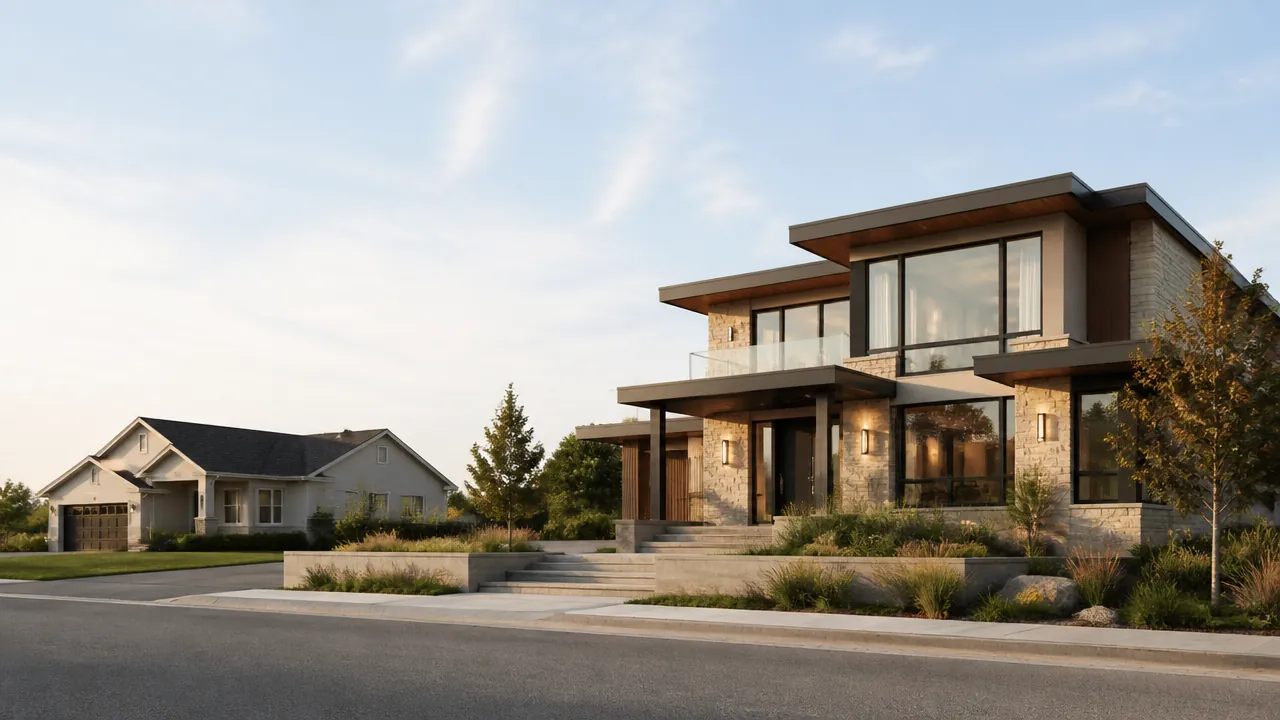
Premium Home vs Standard Home: How to Decide Whether a Luxury Upgrade Is Worth the Cost
Choosing between a premium home and a standard home is not simply a question of how much you want to spend. It is a decision about what the extra money will buy—and whether those benefits will matter to your household for years to come.
A premium home can be worth the cost when it offers lasting advantages such as a better location, stronger construction, a more useful layout, improved energy performance, greater privacy, or better accessibility. It may be less worthwhile when the premium pays mainly for decorative finishes, rarely used rooms, or features that do not suit the surrounding market.
The most reliable way to compare a premium home vs standard home is to look beyond the purchase price. Consider the full cost of ownership, how often you will use each feature, how difficult it would be to add later, and whether the property fits its neighborhood.
The best premium upgrade is not always the most impressive one. It is the feature that continues to improve your daily life without weakening your financial flexibility.
What separates a premium home from a standard home?
A standard home is not necessarily inferior. It may offer sound construction, a practical layout, a suitable location, and reasonable operating costs without including high-end finishes or specialized amenities.
A premium home usually combines several of the following:
- A desirable or hard-to-replicate location
- A larger or better-positioned lot
- Privacy, views, outdoor space, or access to amenities
- Higher-quality structural and building components
- More natural light and a carefully planned floor plan
- Energy-efficient heating, cooling, insulation, and windows
- Premium kitchens, bathrooms, appliances, or interior finishes
- Additional convenience, entertainment, wellness, or accessibility features
The important distinction is between lasting property advantages and replaceable decoration. A home with excellent light, privacy, and construction quality may retain its appeal better than one with expensive finishes in an inconvenient location.
Location, lot, views, and privacy
Location is among the most difficult features to change. You can renovate a kitchen, replace flooring, or repaint walls, but you cannot move a home closer to work, improve its surrounding streets overnight, or recreate a protected view easily.
Lot characteristics can also make a major difference. A premium may be easier to justify when it buys:
- A quieter street
- Better orientation and natural light
- A larger or more usable outdoor area
- Greater separation from neighboring homes
- A view that is unlikely to be blocked
- Easier access to schools, transportation, employment, or daily services
These benefits can influence both your quality of life and the property’s appeal to future buyers. However, the premium should still be tested against comparable homes nearby. A desirable feature has more value when buyers in that area consistently seek it and pay for it.
Layout, natural light, and construction quality
A well-designed layout can improve everyday living more than a collection of luxury finishes. Consider whether the home has:
- Rooms that match your household’s routines
- Sufficient storage
- A practical relationship between the kitchen, dining, and living areas
- Private bedrooms or workspaces
- Flexible rooms that can change purpose over time
- Convenient circulation and minimal wasted space
- Good daylight and ventilation
Construction quality also matters. Durable roofing, plumbing, electrical systems, windows, and exterior materials may reduce future repair needs and improve comfort. A premium home should not receive credit merely for looking expensive; inspect the condition and quality of the components beneath the finishes.
Performance features versus decorative finishes
Premium features generally fall into two groups:
- Performance features: insulation, air sealing, efficient heating and cooling, quality windows, water-saving fixtures, durable materials, and accessibility improvements.
- Decorative or lifestyle features: designer cabinetry, luxury appliances, elaborate lighting, custom millwork, home theaters, wine rooms, and resort-style landscaping.
Both groups can be valuable, but they create value in different ways. Performance features may improve comfort and lower operating costs. Decorative features may deliver enjoyment and visual appeal, but their resale contribution can vary significantly.
Start with what you can comfortably afford
The right premium home is one you can own comfortably—not simply one for which a lender approves you.
Calculate the full monthly cost of ownership
Compare the total monthly cost of each property, including:
- Mortgage principal and interest
- Property taxes
- Home insurance
- Utilities
- Routine maintenance
- Planned maintenance reserves
- Association or community fees
- Landscaping, pool, security, or service contracts
- Transportation costs related to the location
A premium home may have higher insurance, larger utility bills, more complex systems, or greater maintenance needs. A property with extensive landscaping, a pool, elevators, smart-home equipment, or specialty climate systems can carry ongoing costs that are easy to overlook during a viewing.
For example, a standard home might cost $3,200 per month for the mortgage and taxes, plus $450 for utilities and maintenance. A premium home could cost $4,100 for the mortgage and taxes, plus $850 for utilities, maintenance, and association fees. The difference is not just the higher purchase price; it is an additional $1,300 every month.
Protect your emergency savings and financial flexibility
A premium home becomes risky when it leaves little room for unexpected expenses or changing circumstances. Before stretching for an upgrade, consider whether you will still be able to:
- Maintain an emergency fund
- Save for retirement or education
- Handle a temporary income reduction
- Pay for repairs or medical expenses
- Meet other debt obligations
- Continue saving for future goals
Financial flexibility is part of affordability. A home that looks manageable on paper may feel burdensome if every spare dollar is committed to the property.
Compare cash remaining after closing, not just the purchase price
A useful comparison includes your cash position immediately after buying. Account for the down payment, closing costs, moving expenses, furnishing, immediate repairs, and planned improvements.
A lower-priced standard home may require a $25,000 renovation soon after closing. A premium home may cost more upfront but need no major work for several years. Conversely, the premium home may leave you with too little cash for emergencies. The better choice depends on the complete financial picture.
Prioritize premium features that are difficult to change later
When comparing a luxury home vs practical home, ask which differences are permanent, disruptive, or expensive to retrofit.
Why location and lot quality usually matter more than finishes
A kitchen can be updated in stages. A lot cannot be enlarged easily, and a poor location cannot be corrected through interior design. If the premium buys a better setting, privacy, light, or outdoor space that your household will use daily, it may have stronger long-term value than a premium countertop or appliance package.
This does not mean every expensive location is a good investment. The price still needs to fit local comparable sales and your ownership plans. A great location bought at an excessive premium can remain financially difficult to justify.
When floor plans, structural quality, and natural light justify a premium
A premium may be defensible when the home solves a problem that would otherwise affect you every day. Examples include:
- A separate office for someone working from home
- A ground-floor bedroom for aging in place
- A wider, more accessible floor plan
- A quiet bedroom away from traffic and entertainment areas
- Better daylight in the rooms your household uses most
- A structurally sound home that avoids major near-term repairs
These features can support comfort, safety, and convenience—not just prestige.
Which features are expensive or disruptive to retrofit
Prioritize features that require major structural work, such as:
- Relocating bathrooms or kitchens
- Adding windows or changing the home’s orientation
- Improving ceiling height or room proportions
- Rebuilding stairs or improving accessibility
- Adding significant insulation where access is limited
- Reworking plumbing, electrical capacity, or heating and cooling distribution
- Creating a private outdoor area where the lot does not allow one
By contrast, paint, lighting, cabinet hardware, some appliances, and certain flooring choices can often be changed later with less disruption.
Separate energy and comfort upgrades from luxury extras
Not every premium home upgrade is about appearance. Some improvements can affect comfort, resilience, and operating costs.
Insulation, air sealing, and efficient heating and cooling
A well-insulated and properly air-sealed home can be more comfortable throughout the year. Efficient heating and cooling equipment may also reduce energy consumption, particularly when it is correctly sized and maintained.
Look for evidence rather than relying on marketing language. Ask about:
- Insulation levels and where insulation is installed
- Air leakage and drafts
- The age and efficiency of heating and cooling equipment
- Ventilation and indoor air quality
- Utility history, where available
- Recent energy assessments or performance testing
An energy-efficient home upgrade may be worth more than a decorative luxury if it improves comfort every day and lowers recurring costs.
Windows, water efficiency, and durable building components
Quality windows can improve temperature control, noise reduction, and daylight. Water-efficient fixtures can reduce consumption, while durable roofing, siding, flooring, and exterior materials may reduce replacement frequency.
However, “premium” does not automatically mean efficient or durable. Confirm the specifications, installation quality, age, warranties, and maintenance requirements.
Estimate savings with an energy audit and payback analysis
For an existing home, an energy assessment can help identify where improvements are likely to have the greatest effect. Compare the estimated project cost with expected annual savings and the time required to recover the investment.
For example, suppose improved insulation costs $8,000 and is expected to save $800 annually in energy costs. The simple payback period is about 10 years, before considering comfort and future energy prices. If you plan to stay for 15 years, the improvement may be more compelling than if you expect to move in three years.
Calculate the total cost of owning a premium home
The cost of owning a luxury home includes more than the mortgage. For each premium feature, estimate its complete financial impact.
Include installation, financing, maintenance, utilities, and replacement costs
Ask:
- What is the purchase or installation cost?
- Will the cost be financed, and what interest will that add?
- Does the feature require specialist maintenance?
- How much energy or water does it use?
- How often will components need replacement?
- Will insurance or association fees increase?
- What happens if the feature fails?
A large aquarium, pool, elevator, smart-home system, or specialized heating system may be attractive, but each can add service, repair, and replacement obligations.
Compare premium operating costs with standard-home expenses
Create a line-by-line comparison rather than relying on a general assumption that one home is “more efficient.” A standard home with older equipment may have high energy bills, while a premium home with a large footprint may also consume more energy despite better systems.
Compare at least one year of estimated or historical costs where possible. Include maintenance reserves for major items such as roofing, heating and cooling equipment, exterior painting, appliances, and landscaping.
Estimate the upgrade’s likely contribution to resale value
A home upgrade return on investment is rarely guaranteed. Some improvements appeal broadly, while others are highly personal. Resale value is usually stronger when an upgrade improves a property’s function, condition, efficiency, or compatibility with buyer expectations in that area.
Treat resale estimates as probabilities, not promises. A feature that costs $40,000 may add enjoyment worth far more to you, but that does not mean it will add $40,000 to the eventual sale price.
Distinguish lifestyle value from investment value
A home is both a financial asset and a place to live. Those two forms of value should be considered separately.
When designer kitchens and luxury appliances are worth it for you
A designer kitchen may be worthwhile if your household cooks frequently, entertains often, or expects to remain in the home long enough to enjoy the improvement. Premium appliances may also be justified when they solve a genuine need, such as improved accessibility, reliability, or capacity.
The key is to identify the benefit before admiring the specification. “Would this make our daily routine better?” is more useful than “Does this look expensive?”
Why theaters, wine rooms, custom millwork, and resort landscaping may not pay back fully
Specialty features can narrow the future buyer pool. A theater may be valuable to a movie enthusiast but less useful to a buyer who needs another bedroom or a home office. Elaborate landscaping may be beautiful but expensive to maintain. Custom millwork may suit your taste but require alteration for someone else.
These features can still be worthwhile as lifestyle purchases. Just avoid treating them automatically as investments.
Use frequency of use to measure a feature’s real value
Estimate how often you will use a feature and for how many years. If a $12,000 upgrade will be used 1,000 times over five years, its incremental cost is about $12 per use before maintenance. If a $50,000 specialty room will be used 20 times a year for five years, the cost per use is much higher.
This is not a perfect financial calculation, but it reveals whether a feature supports your real lifestyle or merely your idealized one.
Check whether the premium home fits its neighborhood
A highly upgraded property may not receive full recognition from the local market if it is unusual compared with nearby homes.
Compare the property with similar nearby homes
Review homes with similar locations, sizes, lot characteristics, condition, and age. Compare not only asking prices but also recent sale prices, time on the market, and the features buyers appear to value.
A premium home should be judged against its most relevant alternatives—not against the cost of building every feature from scratch.
Avoid over-improving beyond the local buyer pool
If most nearby homes are practical and moderately priced, a property with an exceptionally high level of customization may take longer to sell. The buyer who appreciates every upgrade may be difficult to find, and financing or appraisal may not recognize all the added cost.
This is especially important when a home has a very large price gap above comparable properties.
Consider location, comparable sales, and resale liquidity
Ask whether the premium is supported by the neighborhood’s buyer demand. A well-located premium home in a market with strong demand may have better resale liquidity than a highly customized home in a less established area.
Location versus home features is not an either-or question. The strongest combination is usually a good location, sound construction, useful design, and a level of finish that fits the market.
Use the buy-now-or-renovate-later test
The question is not always “premium or standard?” It may be “which features should I buy now, and which can I add later?”
Buy structural and performance features that are hard to add later
Consider buying a home with the right:
- Location and lot
- Floor plan
- Natural light
- Privacy
- Structural condition
- Accessibility
- Insulation and major systems
- Electrical, plumbing, and heating capacity
These features may require major disruption or excessive cost to add later.
Defer cosmetic upgrades that can be completed gradually
You may be able to defer:
- Paint and wallpaper
- Light fixtures
- Cabinet fronts and hardware
- Some flooring
- Window treatments
- Landscaping details
- Select appliances
- Decorative wall treatments
A practical home with a strong foundation can become more personalized over time without forcing you to pay for every upgrade at closing.
Compare the cost of waiting with the cost of paying a premium today
Waiting has costs too. Renovation prices may rise, projects may disrupt your routine, and you may not be able to recreate an original feature. Estimate both options honestly:
- Premium price today
- Renovation cost later
- Financing and carrying costs
- Temporary housing or disruption
- Risk of unexpected construction issues
- Value of using the feature immediately
When a premium home is more likely to be worth the cost
The premium option is generally more defensible when:
- You expect to stay for a long period
- You will use the features frequently
- The home has a strong location and suitable lot
- Construction quality and condition are sound
- Performance features improve comfort or reduce operating costs
- The premium is supported by nearby comparable sales
- You can maintain savings and financial flexibility after closing
- The layout supports your household’s current and future needs
Even in these circumstances, verify the numbers. A long ownership period does not make an unaffordable purchase safe.
When a standard home is the more practical choice
A standard home may be the better decision when:
- The premium mainly pays for cosmetic finishes
- The property is priced far above similar nearby homes
- Specialty rooms will rarely be used
- You expect to move before the benefits accumulate
- The premium home has unusually high maintenance or operating costs
- The larger payment would reduce emergency savings
- You can add the features later at a reasonable cost
- The standard home has the better location or more adaptable layout
Choosing a standard home is not settling. It may be a deliberate decision to preserve cash, reduce risk, and customize only the improvements that matter most.
A side-by-side premium versus practical home budget
Build a simple comparison before making an offer.
| Cost or benefit | Premium home | Standard home |
|---|---|---|
| Purchase price | $650,000 | $520,000 |
| Down payment and closing costs | $143,000 | $114,000 |
| Estimated monthly housing payment | $3,850 | $3,050 |
| Taxes, insurance, and association fees | $700 | $520 |
| Utilities and maintenance reserve | $850 | $600 |
| Immediate upgrades | $5,000 | $35,000 |
| Cash remaining after closing | $42,000 | $66,000 |
| Expected ownership period | 10 years | 10 years |
In this example, the premium home reduces the need for immediate renovations and may offer better comfort. The standard home leaves more cash available and may be attractive if its location and layout are equally suitable. The decision depends on whether the premium features justify the additional monthly cost and lower post-closing reserves.
Final checklist: score each premium feature before you decide
Score every major difference from 1 to 5:
Frequency of use and lifestyle benefit
- How often will we use it?
- Does it improve a routine we already have?
- Will we still value it in five or ten years?
Comfort, safety, accessibility, and operating-cost benefits
- Does it improve temperature control, air quality, noise, or convenience?
- Does it support mobility, aging in place, or household safety?
- Could it reduce utility, maintenance, or replacement costs?
Retrofit difficulty, resale appeal, and neighborhood fit
- Would adding it later require structural work?
- Is it broadly appealing to future buyers?
- Is the premium consistent with comparable homes nearby?
- Could the feature make the property harder to sell?
Then compare the total ownership budgets, not just the scores. The right choice is the home with the strongest combined lifestyle and financial case.
FAQ: Premium Home vs Standard Home
Is a premium home a good investment?
It can be, but premium does not automatically mean better investment performance. A strong location, sound construction, practical layout, and efficient systems may support value. Expensive finishes and highly personal amenities may deliver enjoyment without returning their full cost at resale.
What premium home features usually add the most value?
Features that improve location, privacy, layout, natural light, condition, energy performance, durability, accessibility, or everyday convenience often have broader value than highly specialized decorative features. Local buyer preferences and comparable sales still matter.
Is a luxury home upgrade worth the cost if I plan to sell soon?
Usually, be cautious. A short ownership period may not provide enough time to recover transaction costs or enjoy the benefits of a major upgrade. Cosmetic improvements may also reflect personal taste rather than broad market demand.
Should I buy a premium home or renovate a standard home?
Buy the premium home when it offers features that are difficult or expensive to recreate, such as a better lot, location, layout, natural light, or structural quality. Renovating a standard home may make more sense when the main differences are cosmetic and the home has a strong foundation.
How can I estimate the cost of owning a luxury home?
Add the mortgage, taxes, insurance, utilities, maintenance, association fees, landscaping, specialty services, financing costs, and replacement reserves. Compare these figures with the standard home over the number of years you expect to own each property.
What is the simplest way to decide between a premium and practical home?
Use three tests: Can you afford the full ownership cost while maintaining financial flexibility? Will you use the premium features regularly? Are those features difficult to add later and supported by the local market? If the answer is yes to all three, the premium may be justified. If not, the standard home may be the wiser choice.
Make the decision with a complete ownership view
The premium home vs standard home decision becomes clearer when you separate what you want from what you need, and lifestyle value from investment value. Pay more for advantages that are lasting, useful, difficult to replicate, and appropriate for the neighborhood. Be more cautious when the premium mainly covers decoration, customization, or features you may rarely use.
Download the premium-versus-practical home decision checklist and score each feature by cost, frequency of use, retrofit difficulty, operating savings, resale appeal, and neighborhood fit. Then compare both homes using your full ownership budget—not the purchase price alone.