Real Estate Market

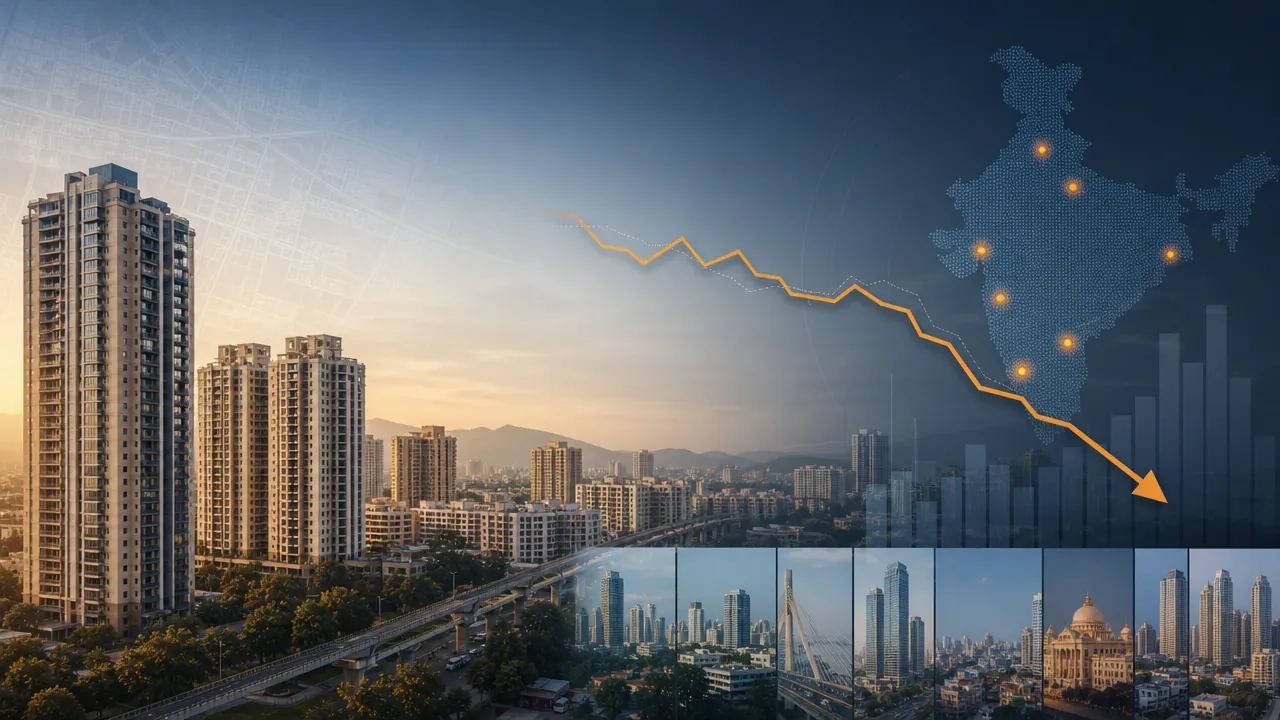
PropEquity Reports 6% Housing Sales Decline Across India’s Top Nine Cities as Thane Launches Fall 28%

4 min readBy AV Properties Mumbai

Quick Answer

PropEquity reported a 6% year-on-year decline in primary-market housing sales across nine major Indian cities during January–June 2025. Thane’s new residential launches fell 28%, signalling more cautious supply decisions rather than proving a broad or lasting housing downturn.

PropEquity Reports 6% Housing Sales Decline Across India’s Top Nine Cities as Thane Launches Fall 28%

India’s residential market showed signs of moderation in the first half of 2025, according to PropEquity. Housing sales across nine major cities fell 6% year on year during January–June 2025, while new residential launches in Thane dropped 28% compared with the same period in 2024.

The figures point to a market that is cooling after several strong quarters—but they do not, by themselves, establish a broad or lasting housing downturn.

What PropEquity’s Housing Sales Data Shows

PropEquity’s comparison covers January to June 2025 against January to June 2024. The nine markets are Mumbai, Navi Mumbai, Thane, Pune, Bengaluru, Hyderabad, Chennai, Kolkata and Delhi-NCR.

The data tracks primary-market residential activity: homes sold by developers and newly launched housing units. “Sales” therefore refers to units sold in the primary market, rather than property registrations, resale transactions or the value of homes sold.

That distinction matters. A fall in unit sales can occur even when overall transaction values remain firm if buyers shift toward smaller homes or if premium housing continues to perform better than mass-market projects.

The 6% decline was spread across the major-city sample, but the report’s Thane figure refers to new launches, not a 28% collapse in Thane sales. Thane’s launch pipeline contracted 28% year on year, making it one of the sharper signs of supply restraint in the Mumbai Metropolitan Region.

Why Thane’s New Launches Fell 28%

PropEquity’s release establishes the scale of the decline, but it does not prove a single cause. The most direct interpretation is that developers launched fewer projects in Thane during the period than in the comparable first half of 2024.

That may reflect project-level timing, approvals and phasing rather than a sudden loss of buyer interest. Developers often stagger launches when existing inventory needs more time to sell, construction costs are being reassessed or infrastructure-linked expectations have not yet translated into immediate demand.

Thane also sits within a highly competitive MMR market. Buyers can compare projects across Thane, Navi Mumbai, the eastern suburbs and peripheral parts of Mumbai, where differences in pricing, commute access, unit size and possession timelines can alter demand from one quarter to the next. The 28% launch decline should therefore be read as a supply signal, not proof that all Thane projects are weakening equally.

Sales Versus New Launches: Is Inventory Pressure Building?

The relationship between sales and launches is more informative than either number alone. If sales decline while launches continue at the same pace, unsold inventory can rise. If both sales and launches soften, developers may be responding to demand rather than adding supply aggressively.

The PropEquity findings suggest the latter pattern in Thane: launch activity was reduced as the broader nine-city market recorded lower sales. That could limit near-term inventory build-up, although the report does not establish how much unsold stock individual projects or micro-markets carry.

For developers, the immediate implication is likely to be greater emphasis on project phasing, product mix and sales velocity. For buyers, fewer launches do not automatically mean lower prices. They may instead mean fewer choices in selected locations, particularly where developers are waiting for clearer demand before releasing new phases.

What the Decline Means for India’s Real Estate Market

The result is significant because it breaks with the uninterrupted growth narrative that has shaped recent Indian real-estate commentary. However, a six-month, year-on-year fall is not enough to classify the market as a durable slowdown.

Other research providers, including ANAROCK and Knight Frank India, publish city-level housing indicators, but their conclusions may differ because they use different city groupings, reporting windows and measures of sales or launches. Official indicators such as housing-price indexes, mortgage rates and lending conditions also need to be read alongside developer sales data.

For now, PropEquity’s report is best viewed as an early normalization signal: demand has become less uniformly strong, and developers—especially in markets such as Thane—appear more selective about adding supply. The next two reporting periods will show whether this is temporary volatility or the beginning of a broader adjustment in India’s housing market.

Track the latest PropEquity housing sales data and compare city-level trends before making a property purchase or investment decision.

Key Takeaways

  • Primary-market housing sales across nine major Indian cities declined 6% year on year in the first half of 2025.
  • The cities covered were Mumbai, Navi Mumbai, Thane, Pune, Bengaluru, Hyderabad, Chennai, Kolkata and Delhi-NCR.
  • Thane recorded a 28% year-on-year fall in new launches, not a confirmed 28% drop in housing sales.
  • Lower launches may reflect project phasing, approvals, inventory management or developer caution rather than weakening demand alone.
  • The data is an early normalization signal, and additional reporting periods are needed to confirm a broader market correction.

Key Facts & Figures

FactContext
Primary-market housing sales across nine major Indian cities fell 6% year on year during January–June 2025.Attribution: PropEquity’s comparison of January–June 2025 with the same period in 2024. The measure refers to homes sold by developers, not resale transactions or property registrations.
New residential launches in Thane declined 28% year on year during the first half of 2025.Attribution: PropEquity’s reported city-level launch data. The statistic describes new supply entering the market and should not be presented as a 28% decline in Thane housing sales.
The PropEquity comparison covers nine markets: Mumbai, Navi Mumbai, Thane, Pune, Bengaluru, Hyderabad, Chennai, Kolkata and Delhi-NCR.Attribution: The city coverage specified in the PropEquity report discussed in the article. Differences in city groupings and measurement methods can produce different results across research providers.

How to Apply This Guide

  1. Define the market measures: Separate primary-market developer sales, new launches, property registrations, resale transactions and transaction value before interpreting the data.
  2. Compare equivalent periods: Compare January–June 2025 with January–June 2024 so seasonal timing and reporting windows remain consistent.
  3. Analyse sales alongside launches: Assess whether sales and new supply are rising or falling together to identify potential inventory pressure or deliberate supply restraint.
  4. Check city-level differences: Compare Thane with Mumbai, Navi Mumbai and other major markets while accounting for pricing, connectivity, unit mix and project timelines.
  5. Validate the trend with multiple indicators: Review subsequent reporting periods, housing-price indexes, mortgage conditions, lending data and research from other providers before concluding that a durable downturn has begun.

Frequently Asked Questions

What did PropEquity report about housing sales in India?

PropEquity reported a 6% year-on-year decline in primary-market housing sales across nine major Indian cities during January–June 2025. The comparison covers Mumbai, Navi Mumbai, Thane, Pune, Bengaluru, Hyderabad, Chennai, Kolkata and Delhi-NCR. The data measures developer-sold homes rather than registrations or resale transactions.

Did Thane housing sales fall 28%?

No, the 28% figure refers to Thane’s year-on-year decline in new residential launches. PropEquity’s reported figure indicates reduced supply entering the market, but it does not establish that Thane sales fell by 28% or that every local project weakened.

Why did new launches in Thane decline?

The available PropEquity data does not prove one specific cause for Thane’s 28% launch decline. Project approvals, launch timing, inventory management, construction costs, product mix and developer caution may all influence when new phases are released. Competitive conditions across the wider Mumbai Metropolitan Region can also affect launch decisions.

Does the 6% housing sales decline indicate a property market crash?

No, a six-month year-on-year decline alone does not establish a housing market crash. It is better interpreted as an early moderation or normalization signal, especially because sales and launches can vary by city, segment and reporting methodology. Further quarters and independent indicators are needed to determine whether the trend is temporary or structural.

What does the data mean for property buyers and developers?

Buyers may face fewer new project choices in some Thane micro-markets, while developers may focus more on phasing, product mix and sales velocity. Fewer launches do not automatically mean lower prices because supply restraint can limit availability. Buyers should compare project-level inventory, pricing, approvals, possession timelines and competing locations before making a decision.

PropEquity housing salesIndia housing sales 2025Thane housing launches declineThane real estate marketMumbai residential property markettop nine cities housing salesIndia property market slowdownnew residential launches Indiaprimary housing market India
Home
Residential
Commercial
Contact