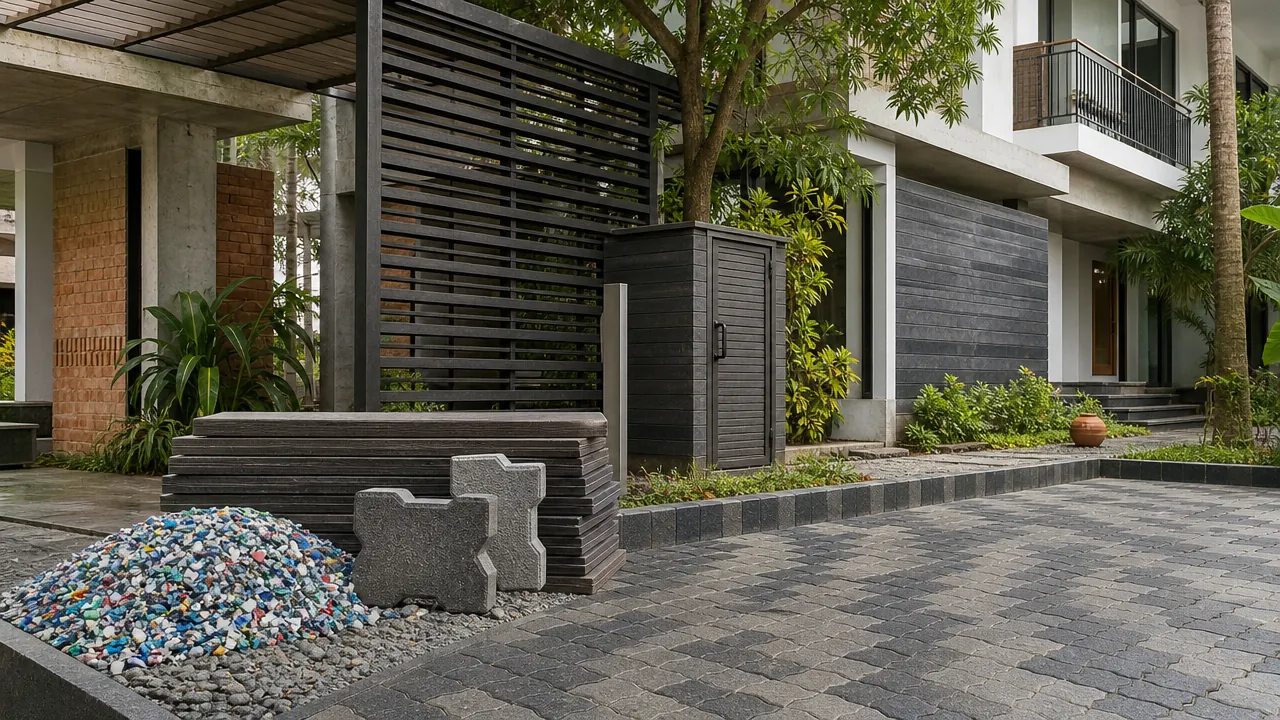
Could Recycled Plastic Become a Building Material for Indian Homes? Benefits, Risks and What to Check
Recycled plastic is moving from waste-management conversations into construction products. In India, manufacturers are exploring recycled plastic pavers, roofing sheets, wall panels, boards, doors, furniture and even non-load-bearing blocks.
But a recycled plastic product is not automatically a replacement for brick, concrete or steel. Its suitability depends on the polymer used, how the material was processed, the product design, its installation and the conditions it will face over time.
For most homeowners, the safest approach is to treat recycled plastic building materials as product-specific building components. Use them where their performance has been tested, and require engineering evidence before considering them for structural work.
A product made from recycled plastic may be useful, durable and environmentally responsible—but only if its actual performance matches the job it is expected to do.
This guide explains where these materials may work in Indian homes, the major risks to investigate and the documents to request before purchase.
Recycled Plastic Building Materials Are Promising—but Not a Universal Substitute for Brick and Concrete
What “recycled plastic” means in construction
“Recycled plastic” can describe very different materials. A product may be manufactured from post-consumer packaging, industrial scrap, discarded pipes, agricultural films or a mixture of several plastic types. It may be made using processes such as extrusion, compression moulding, injection moulding or composite manufacturing.
The final product could be:
- A solid plastic profile or board
- A plastic-and-mineral composite
- A fibre-reinforced plastic panel
- A polymer-bound block containing sand or other fillers
- A layered roofing sheet
- A paver or kerb made from processed plastic waste
These products do not perform in the same way. A rigid outdoor paver, an indoor partition board and a structural block have different requirements for strength, fire behaviour, water absorption, movement and durability.
The phrase recycled plastic building materials therefore tells you what some of the feedstock is—not whether the product is suitable for a particular wall, roof or floor.
Why the product and the complete building assembly matter more than the material label
A building component works as part of a system. For example, the performance of a wall panel depends on the panel, framing, fasteners, joints, insulation, plaster or finish and the surrounding openings.
Likewise, a roofing sheet must be assessed with its overlaps, screws, support spacing, flashing, sealants and drainage details. A material that performs well in a laboratory sample can still leak, warp or fail if installed incorrectly.
The National Building Code of India 2016 recognises the need to evaluate alternative materials and maintain requirements for structural and fire safety. It does not automatically approve every product described as recycled, sustainable or innovative.
Where Recycled Plastic May Work Well in Indian Homes
Different applications carry different levels of risk. Products that are non-structural, replaceable and exposed to manageable loads are generally easier to assess than columns or foundations.
Pavers, kerbs, drain covers and other outdoor products
Recycled plastic pavers may be considered for selected walkways, garden paths, terraces, courtyards and low-traffic areas. Kerbs, drain covers, landscaping edging, bins and site furniture are other possible applications.
Before installation, check the specific requirements for the location. A driveway paver must handle vehicle loads, while a balcony paver must resist weather and provide adequate slip resistance. A drain cover needs strength, impact resistance and safe support at its edges.
For example, a lightweight recycled plastic paver may be suitable for a garden path but unsuitable for a driveway unless it has been tested for the expected wheel loads and installed over the recommended base.
Wall panels, boards, partitions and doors
Recycled plastic wall panels and boards may work in non-structural interior applications such as:
- Office or home partitions
- Utility-room lining
- Storage areas
- Decorative wall cladding
- Temporary or modular rooms
- Cabinet shutters and doors
The key questions are whether the product is suitable for indoor use, how it reacts to heat and moisture, whether it releases odour, and how it behaves near electrical points, kitchens and cooking areas.
A board used as a decorative lining is not automatically suitable as a fire-rated partition. The framing and fixing method also need to be included in the test or design information.
Roofing sheets and weather-exposed components
Recycled plastic roofing sheets may be useful for sheds, verandas, utility areas, agricultural structures or other applications where the manufacturer has provided appropriate test data.
Check performance for:
- Solar heat and high surface temperatures
- Ultraviolet exposure
- Rain and humidity
- Wind uplift
- Impact from hail or falling objects
- Expansion and contraction
- Fire and smoke
- Fixing and overlap details
A roof sheet can remain waterproof while still becoming brittle, sagging between supports or expanding enough to loosen fixings. Do not judge a product only by its appearance immediately after installation.
Non-load-bearing recycled plastic blocks
Some recycled plastic bricks or blocks are marketed for partitions, landscaping, temporary structures or infill. These may be useful where they do not carry the weight of floors, beams or roofs.
However, “non-load-bearing” must be confirmed in the design—not assumed from the product name. The wall may still need to resist wind, impact, its own weight and the loads transferred by doors, cabinets or attached fixtures.
Ask for the permitted use, maximum wall height, recommended mortar or adhesive, anchoring details and restrictions around openings.
Furniture, bins and site infrastructure
This is often one of the more practical starting points for plastic waste building materials. Benches, dustbins, storage units, planter boxes, fencing components and construction-site furniture can use recycled plastic without becoming part of the primary structural system.
These products still need to be durable and safe. Outdoor furniture should be assessed for UV exposure, heat, splinters, sharp edges and stability. Bins and storage products should be checked for cleaning chemicals, odour and load capacity.
Where Recycled Plastic Should Not Be Used Without Engineering Evidence
Load-bearing walls and structural blocks
A load-bearing wall transfers the weight of the roof, floors and other elements to the foundation. Its performance depends on compressive strength, stability, slenderness, connections, openings, moisture conditions and long-term deformation.
A laboratory result for a small recycled plastic brick does not by itself prove that a complete wall is safe for an occupied home. Structural use should require product-specific test data, a qualified structural engineer’s design and approval under the applicable building-control process.
Columns, beams and foundations
Columns, beams and foundations are safety-critical. They are exposed to permanent loads, changing loads, settlement, temperature effects and connection forces. Replacing concrete or steel with a plastic composite requires much more than a strength comparison.
An engineer must also consider stiffness, creep, fire resistance, buckling, reinforcement, connection behaviour and long-term ageing. A material that supports a short-term load in a test may deform under a constant load over many years.
Do not use recycled plastic products for columns, beams, slabs or foundations based only on a brochure, a demonstration building or an informal recommendation.
Why a product test report is not the same as approval for an entire house
A report may test one property under one set of conditions. It may not cover:
- A different production batch
- A different thickness or profile
- Outdoor exposure
- Fire performance of the installed assembly
- Connections and fasteners
- Local soil, wind or seismic conditions
- Plumbing and electrical penetrations
- Construction quality on the actual site
Approval is based on the proposed use, design and applicable requirements—not simply on the presence of a test certificate.
Potential Benefits of Plastic Waste Building Materials
Diverting suitable plastic waste from disposal
Recycling suitable plastic into construction products can create a market for material that might otherwise be discarded. It can also support plastic waste segregation and formal processing.
The benefit depends on the feedstock. Clean, correctly identified and consistently processed plastic is easier to control than mixed, wet or contaminated waste. A product made from poorly sorted material may have inconsistent strength, colour, odour or durability.
Reducing dead load with lightweight products
Some plastic composite products weigh less than concrete or masonry. Lower dead load may reduce handling effort and simplify installation. In a renovation, a lightweight partition or panel can sometimes be more practical than a heavy masonry wall.
The saving must be calculated, not assumed. A lighter product may need closer supports, thicker sections, additional framing or stronger fixings. A structural engineer must recalculate the building loads before any structural change.
Improving moisture resistance in selected applications
Many plastic-based products absorb little water compared with porous materials. This can be useful for selected outdoor products, wet-area linings, storage units or landscaping applications.
Low absorption does not guarantee a watertight building. Water can enter through joints, screw holes, cracks, unsealed edges, roof overlaps or the surrounding masonry. The complete assembly and drainage design remain important.
Supporting thermal and acoustic performance when the full assembly is tested
Plastic products may contribute to insulation or sound reduction, but the material label alone does not establish performance. Thermal conductivity, surface temperature, sound transmission and condensation risk should be assessed for the complete wall or roof assembly.
For example, a hollow panel may perform differently when filled with insulation and fixed to a metal frame. A thin plastic board may reduce air movement without providing meaningful sound insulation.
Enabling faster installation and less site waste
Prefabricated panels, modular partitions and dry-assembled products may reduce cutting, curing and wet-work time. They can also generate less site waste than products that require extensive on-site fabrication.
This benefit is more plausible for selected components than for replacing an entire structural house. Faster installation is valuable only when the product has clear instructions and trained installers are available.
The Main Risks of Recycled Plastic Construction Materials in India
Fire, smoke and toxic combustion products
Fire is one of the most important concerns. Plastic products can ignite, melt, soften, spread flame or produce smoke and toxic combustion products. Recycling does not make a plastic product fire-safe.
Ask for evidence covering the exact product and intended assembly. Relevant information may include ignition, flame spread, smoke generation, fire resistance and the duration for which the assembly maintains its function.
A “fire-resistant” claim without a test report is not enough, especially for products used in escape routes, kitchens, electrical rooms, staircases, ceilings or shared residential buildings.
Heat, ultraviolet exposure and dimensional movement
Indian homes may experience intense sunlight, high roof temperatures, monsoon moisture and substantial day-to-night temperature changes. Plastic products can expand, contract, soften, become brittle or lose colour under these conditions.
For external applications, request data on UV ageing, weathering, maximum service temperature, thermal expansion and long-term deformation. Installation details should allow for movement where necessary.
Structural uncertainty, creep and long-term ageing
Some plastic materials deform gradually under a constant load. This behaviour, known as creep, can affect roofs, shelves, panels, blocks and connections. A product can meet its initial strength target yet sag or loosen after years of use.
Request compressive, flexural, impact and creep data appropriate to the application. Also ask whether the results represent accelerated ageing, natural weathering or only a short-term laboratory test.
Variable feedstock, contamination and inconsistent batches
The type of polymer, additives, fillers, pigments, moisture and contamination can change the final product. Mixed feedstock may make quality control more difficult.
A responsible manufacturer should be able to explain how plastic is segregated, processed, identified and tested. Batch traceability matters because the product installed next year should not silently differ from the product approved today.
Joints, fixings and compatibility with other building systems
Failure often occurs at an interface rather than in the panel or block itself. Plastic can move differently from concrete, brick, metal or plaster. Screws may loosen, sealants may fail and adhesives may not bond reliably in heat or moisture.
Check whether the product is compatible with:
- Cement plaster and tile adhesives
- Paints, sealants and waterproofing systems
- Electrical conduits and switches
- Plumbing fixtures
- Metal framing and fasteners
- Insulation and fire-stopping materials
How to Check the Quality of Recycled Plastic Building Materials
Before purchase, request a technical file rather than relying on a product sample or marketing claim.
Confirm the polymer type, recycled content and source of the waste
Ask what polymers are present and whether the product contains fillers or other materials. Request the percentage of recycled content and an explanation of whether it is post-consumer, post-industrial or mixed waste.
Also ask how the waste is collected and processed. Legally managed, segregated and properly processed waste is preferable to an undocumented supply chain.
Request batch traceability and manufacturer documentation
The documentation should identify the manufacturer, product model, dimensions, manufacturing date, batch number and intended use. It should also state storage, handling, installation and maintenance requirements.
Be cautious if a supplier cannot identify the factory, testing laboratory or production batch.
Review strength, density, water absorption and impact data
The relevant tests depend on the product, but may include:
- Density and weight per unit area
- Compressive strength
- Flexural or bending strength
- Impact resistance
- Water absorption
- Dimensional stability
- Slip resistance for flooring
- Load capacity for covers, shelves or panels
The results should state the test method, sample dimensions, test date and acceptance criteria. A single impressive number is not a complete assessment.
Check thermal, acoustic, UV and weathering performance where relevant
For a roof or external wall, request thermal, weathering and UV data. For an internal partition, ask about sound transmission and fire performance. For a wet-area product, check water, mould and cleaning-chemical resistance where applicable.
Match the test report to the exact product and intended use
Confirm that the report covers the same thickness, profile, composition and installation method that you intend to buy. A report for a laboratory tile should not be used to justify a different roofing sheet.
Fire-Safety Checks Every Homeowner Should Make
Ask for fire, flame-spread, smoke and fire-resistance test results
Request an applicable Indian or internationally recognised fire-test report for the exact product and assembly. The report should clarify what was tested and whether the result applies to the installed configuration.
For a wall or roof, this may include the supporting frame, insulation, joints, fasteners, coatings and penetrations—not just a loose piece of plastic.
Assess the complete wall, roof or partition assembly
A panel may behave differently when it is exposed on both sides, covered with plaster, installed behind insulation or joined to another material. Fire-stopping around electrical and plumbing penetrations may also be required.
A fire consultant or architect should review products used in multi-storey buildings, common corridors, staircases and other areas where evacuation is critical.
Do not rely on claims such as “eco-friendly” or “fire-resistant” without evidence
Terms such as “green”, “non-toxic”, “safe” and “fire-resistant” are not substitutes for test documentation. Ask what was tested, by whom, under which method and for how long.
BIS Standards, the National Building Code and Local Approval in India
What the National Building Code of India 2016 means for alternative materials
The National Building Code of India 2016 provides a framework for building safety, including structural design, fire safety, services and the use of alternative materials. It should be treated as a safety baseline, not as a blanket endorsement of every new product.
The applicable requirements can vary with building type, height, occupancy, location and local approval process.
When BIS specifications or product certification may apply
Some products may be covered by relevant Indian Standards, project specifications or certification requirements. Others may need evaluation using an appropriate test method because they are new or not directly covered by an existing standard.
Ask the supplier which specification applies and whether certification is mandatory, voluntary or unavailable for that product category. Do not treat a company quality certificate as equivalent to independent product certification.
Why structural calculations and local building approval still matter
Even a well-tested product must be incorporated into an approved design. Confirm structural calculations, fire-safety provisions, electrical and plumbing compatibility, installation details and local building permissions before work begins.
A qualified architect, structural engineer or building professional should review any product used beyond low-risk decorative or site applications.
An Environmental Checklist for Recycled Plastic Homes
Verify that the plastic waste is legally collected and properly processed
Ask whether the supplier works with authorised waste processors and whether the feedstock is segregated. Proper processing helps reduce contamination and improves consistency.
The environmental benefit is weaker if the product depends on unsafe handling, uncontrolled burning, illegal dumping or a waste stream that cannot be verified.
Compare whole-life impacts instead of assuming recycled content is always greener
Consider manufacturing energy, transport, additives, maintenance, replacement frequency, durability and end-of-life options. A lightweight product may reduce transport emissions, while a short-lived product may need frequent replacement.
Compare the proposed product with a suitable conventional alternative for the same service life and performance—not merely by recycled-content percentage.
Ask how the product can be repaired, reused or recycled at end of life
Mixed-material composites can be difficult to recycle again. Ask whether damaged pieces can be repaired, reused or returned to the manufacturer. Keep installation and composition records for future owners.
Questions to Ask a Recycled Plastic Building-Product Supplier
Before signing an order, ask:
- What exact polymer types and recycled materials are in the product?
- What percentage is recycled, and can that claim be documented?
- Can you provide independent test reports for this exact product and batch?
- What uses are permitted, and what uses are prohibited?
- Has the product been tested for fire, smoke and flame spread where relevant?
- What are the limits for heat, UV exposure, moisture and chemical contact?
- What support spacing, fasteners, adhesives or sealants are required?
- How should the product be cut, stored, cleaned and maintained?
- What warranty applies, and what events exclude warranty coverage?
- Are replacement pieces available if one panel, paver or sheet is damaged?
- What local approvals or professional sign-offs are required?
- How can the product be repaired, reused or recycled at the end of its life?
The Practical Verdict: Use Tested Components Before Considering a Recycled Plastic House
The most defensible applications today
For many Indian homes, the most practical uses are tested pavers, kerbs, drain products, furniture, bins, boards, partitions, doors, selected roofing products and non-load-bearing components.
These applications can still deliver useful benefits such as lower weight, moisture resistance, prefabrication and reduced site waste—provided the product is suitable for the location and correctly installed.
When structural use may be considered
Structural use should be considered only when the complete system has product-specific independent testing, appropriate durability and fire evidence, engineering calculations, qualified installation and local approval.
A demonstration project or successful short-term installation is not enough to establish decades-long safety in a home.
When to reject a product or seek an engineer’s review
Pause the purchase if the supplier cannot provide composition details, batch information, test reports, installation instructions or a clear warranty. Seek professional review for load-bearing walls, roofs, slabs, columns, beams, foundations, multi-storey buildings and fire-critical locations.
The safest buying rule is simple: approve the application, not just the material.
Planning to use recycled plastic building materials? Save this buyer’s checklist, then ask your architect or structural engineer to review the product’s test reports, fire performance, installation details and local approval before you purchase.
Frequently Asked Questions
Can recycled plastic replace bricks in an Indian home?
It may replace bricks in selected non-load-bearing or decorative applications, but it should not be treated as a universal substitute. Load-bearing walls require product-specific structural evidence, engineering design and approval.
Are recycled plastic bricks strong enough for house construction?
Some products may have useful compressive strength, but a brick test alone does not prove that a complete wall is safe. Wall height, joints, openings, loads, creep, fire performance and connections must also be assessed.
Are recycled plastic roofing sheets suitable for hot Indian climates?
They may be suitable for particular roofs if they have been tested for heat, UV exposure, weathering, wind, impact, fire and dimensional movement. Installation must also allow for expansion and use the specified supports and fixings.
Do recycled plastic building materials absorb water?
Many plastic-based products have low water absorption, but the result varies by composition and manufacturing method. Joints, edges, fixings and the surrounding assembly can still allow water entry.
Are recycled plastic products fire-safe because they are recycled?
No. Recycling does not automatically improve fire behaviour. Request test results for ignition, flame spread, smoke, combustion products and fire-resistance duration where relevant.
What documents should a homeowner request before buying?
Request the manufacturer’s identity, product composition, recycled-content information, batch traceability, dimensions, test reports, installation instructions, maintenance requirements, warranty and details of applicable standards or approvals.
Can recycled plastic homes be environmentally better than conventional homes?
They can offer environmental benefits when suitable waste is responsibly collected, the product is durable and the end-of-life pathway is clear. Recycled content alone does not prove lower whole-life environmental impact.
Should a structural engineer review recycled plastic products?
Yes, especially when the product carries loads, forms part of a roof or floor, affects fire safety, or changes the approved building design. Professional review can identify risks that are not visible from a product sample or brochure.