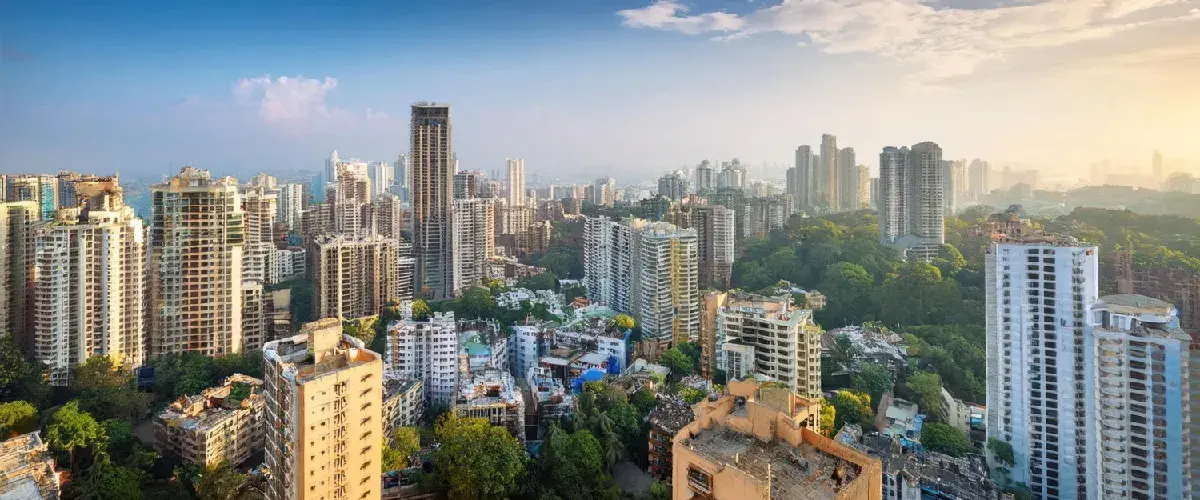
Mumbai has always drawn ambition — but the nature of that ambition is changing. Where previous generations sought a foothold in the city, today's buyers are seeking something more considered: homes that reflect how they live, support how they work, and grow in value as the city around them continues to evolve.
Demand for premium apartments in Mumbai has risen sharply over the past few years, and it isn't driven by a single factor. It is the convergence of several powerful forces — economic, infrastructural, demographic, and cultural — that together are reshaping what Mumbai's homebuyers want and where they are willing to invest.
Understanding these forces matters whether you are buying for yourself or evaluating Mumbai as an investment market. The drivers are structural, not cyclical, which means the demand story has real longevity.
Emergence of powerful new business zones
Mumbai's economic geography has expanded dramatically over the past decade. What was once a city where commerce was concentrated in Nariman Point and Fort has become a multi-nodal metropolis, with major business districts spread across BKC, Lower Parel, Powai, Andheri, and the emerging clusters of Navi Mumbai and the Eastern suburbs. Each new business zone creates its own ring of residential demand, as professionals seek homes within reasonable proximity to their workplaces.
BKC in particular has become one of India's most significant commercial addresses — home to international banks, consulates, media companies, and tech firms. The residential neighbourhoods surrounding it, from Bandra to Kurla to Chembur, have all seen sustained demand from professionals who value the combination of a prestigious work address and a well-connected home. As new office supply continues to develop across the city, this pattern of residential demand following commercial activity will only intensify.
The growth of Mumbai's startup and entrepreneurial ecosystem adds another layer to this demand. Younger founders and senior hires in high-growth companies are increasingly well-compensated and actively seeking premium housing that matches their professional aspirations. This cohort values design, amenities, and location — and they are entering the premium market earlier in their careers than previous generations did.
Enhanced connectivity across the city
Infrastructure investment in Mumbai over the past decade has been transformative. The metro network, long delayed, is now operational across multiple lines with further extensions underway — dramatically reducing commute times for large parts of the city. The Coastal Road project is redefining travel times between South Mumbai and the western suburbs. The Atal Setu bridge has strengthened connectivity between the island city and Navi Mumbai. Together, these projects are effectively shrinking Mumbai's geography.
When commute times fall, the calculus of where to live changes. Neighbourhoods that were previously considered inconvenient become viable. Locations that were already well-connected become even more desirable. Buyers who would once have limited themselves to a narrow band of the city now have genuine choice — and premium developers in newly accessible micro-markets are benefiting directly from this expanded consideration set.
Improved connectivity also supports long-term price appreciation. Historically, properties in areas receiving new infrastructure — whether a metro station, a new road link, or a coastal highway — have appreciated ahead of the broader market in the years following completion. Buyers who identify these locations early and purchase premium inventory capture the infrastructure premium as it is priced in over time.
Need for larger, smarter living spaces
The shift to hybrid and remote working has fundamentally altered what homebuyers need from their homes. A residence that once served primarily as a place to sleep and unwind now needs to function as an office, a gym, a school, and a sanctuary — sometimes simultaneously. This has driven a significant upgrade in the space requirements of Mumbai's professional class, with demand shifting decisively toward larger configurations.
Three-bedroom apartments have become the new benchmark for aspirational buyers — offering enough space for a dedicated work area, comfortable accommodation for a family, and room to host without compromise. For senior professionals, larger families, or buyers seeking investment assets that attract premium tenants, 4 BHK configurations in well-located buildings represent the top of the demand curve.
Beyond raw space, buyers are prioritising intelligent layouts — homes where every square foot is purposeful, where natural light is maximised, where storage is integrated, and where technology is embedded rather than retrofitted. Developers who have responded to this shift with thoughtful design and smart home integration are commanding measurable premiums over competitors offering comparable square footage in less considered packages.
Integration of high-end lifestyle amenities
The definition of what a premium apartment should offer has expanded well beyond the unit itself. Today's buyers are purchasing access to an entire living ecosystem — and the quality of that ecosystem is a primary factor in their purchase decision. Developers who understand this are delivering projects where the amenity offering is as carefully considered as the architecture.
A well-appointed premium development in Mumbai today typically offers a fully equipped fitness centre, swimming pool, landscaped gardens and walking tracks, children's activity zones, multipurpose clubhouses, co-working spaces, EV charging infrastructure, and concierge services. Smart home technology — app-controlled lighting, climate, access, and security — is increasingly standard rather than a differentiating feature.
These amenities serve a dual purpose. For owner-occupiers, they directly enhance quality of life and reduce the need to leave the building for everyday wellness and leisure needs. For investors, they are a strong signal of tenant appeal — high-income renters, NRIs, and expatriates consistently prioritise amenity-rich buildings when choosing where to lease, and they are willing to pay a significant premium for that experience. Projects that deliver on the lifestyle promise command both higher rents and lower vacancy rates.
Growing NRI and global investor interest
Mumbai's premium residential market has become a meaningful destination for international capital, particularly from the Indian diaspora. NRI buyers represent a significant and growing share of premium apartment transactions, drawn by a combination of emotional connection to the city, confidence in India's long-term economic trajectory, and the attractive returns available relative to comparable real estate in the US, UK, or UAE.
Currency dynamics often work in NRI buyers' favour — the relative strength of foreign earnings against the rupee means that premium Mumbai properties represent genuine value when priced in dollars or pounds. This structural advantage, combined with simplified repatriation rules and increased developer transparency under RERA, has lowered the barriers to NRI investment considerably.
Institutional and foreign investors are also taking a closer look at Mumbai's premium residential sector as part of broader India real estate allocations. The formalisation of the market, improving data availability, and the track record of returns in gateway city residential assets have all contributed to growing institutional confidence. This layer of sophisticated, long-horizon capital adds depth and stability to demand that benefits all participants in the market.
Sustainability and wellness as purchase drivers
A newer but increasingly significant factor in premium apartment demand is the importance buyers place on sustainability and wellness features. Green building certifications, energy-efficient systems, air filtration, water recycling, and access to open green space are no longer niche considerations — they are actively influencing purchase decisions, particularly among younger, globally aware buyers.
Developers who have invested in IGBC or LEED certifications, integrated solar energy systems, and created meaningful green space within their projects are finding that these investments translate directly into stronger sales velocity and pricing power. Buyers understand that sustainable buildings have lower operating costs, higher long-term value retention, and a smaller environmental footprint — and they are willing to pay for that combination.
Wellness infrastructure — dedicated yoga and meditation spaces, running tracks, indoor air quality monitoring, and access to natural light throughout common areas — has similarly moved from premium differentiator to expected feature in the top tier of Mumbai's residential market. Developers who treat wellness as a design philosophy rather than a marketing checklist are building the projects that will define the city's premium landscape for the next decade.
Summary
Demand for premium apartments in Mumbai is being driven by a powerful convergence of factors: the expansion of the city's commercial geography, transformative infrastructure investment, evolving space requirements, world-class amenity expectations, growing NRI and global investor participation, and a rising emphasis on sustainability and wellness.
None of these drivers are temporary. Each reflects a structural shift in how Mumbai's most capable buyers think about where and how they want to live. For investors, this means the fundamental case for premium residential real estate in Mumbai is stronger today than it has ever been — and the trajectory points clearly toward continued demand growth in the years ahead.