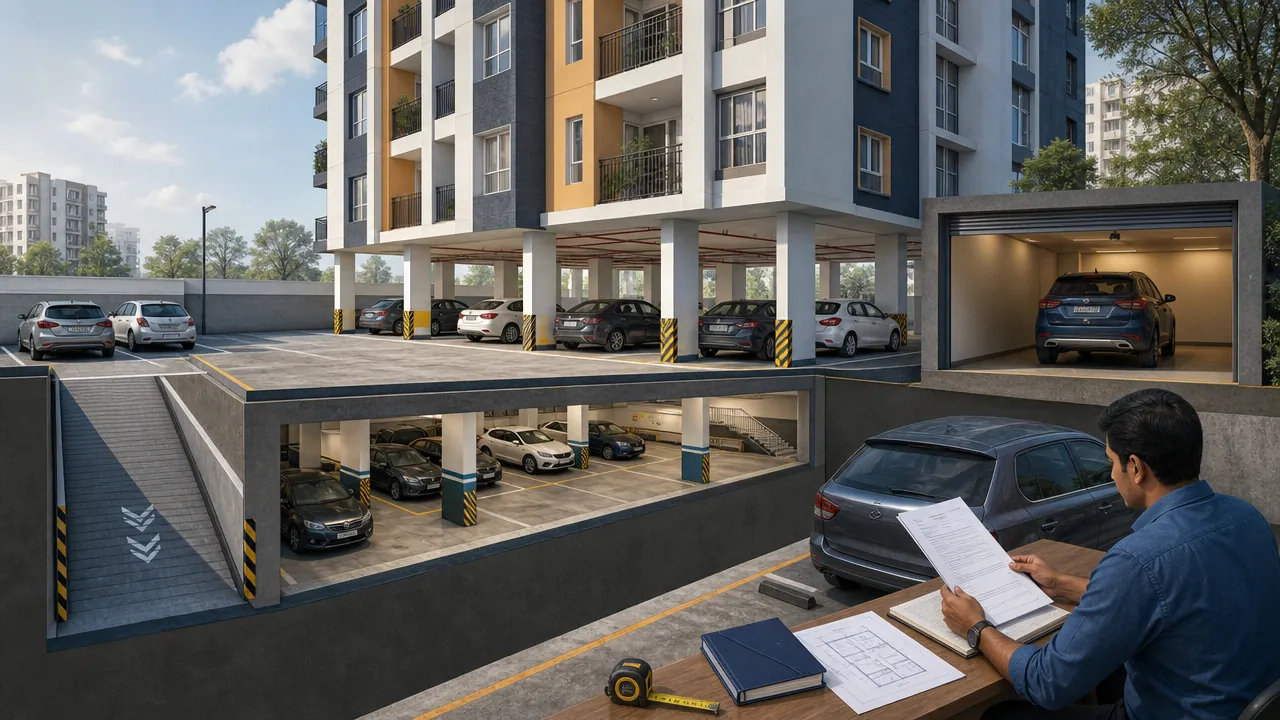
Buying an Apartment in India? How to Verify Parking Rights, Allotment and Extra Charges
A parking space can materially affect the price, convenience and resale value of a flat. Yet many buyers treat parking as an automatic benefit of owning an apartment. That assumption can create disputes over who may use a bay, whether a builder can charge for it, and whether the right continues after resale.
The safer approach is to treat apartment parking rights in India as a documented legal and contractual right. Before paying a parking-related amount, identify the nature of the right, match the space to the approved plans and confirm every charge in writing.
A sales representative’s promise is not a substitute for a clearly described right in the agreement, allotment documents and applicable society rules.
Why Apartment Parking Rights Need Separate Verification
Parking may be described as “included,” “allotted,” “exclusive,” “covered” or “reserved.” These words do not necessarily give you the same legal entitlement. A parking arrangement may involve:
- Ownership of a separately transferable premises, where legally permitted and properly documented
- An exclusive-use right attached to the apartment
- A contractual licence to park a particular vehicle in a particular space
- A parking allotment made by the housing society or association
- A shared or rotating right under apartment society parking rules
The sale document should state precisely which arrangement applies. It should not merely say that the buyer receives “one parking space” without identifying the location, dimensions, conditions and duration of the right.
A parking space may be owned, exclusively used, licensed or allotted by the society
These concepts are different:
| Arrangement | What it may mean | What to verify |
|---|---|---|
| Ownership | A separately recognised property interest, where permitted by law | Whether the space is legally capable of separate ownership and transfer |
| Exclusive use | The buyer can use a particular bay to the exclusion of others | Whether the right is attached to the flat, transferable and recorded in the agreement |
| Licence | Permission to use a space without ownership | Duration, revocation conditions, vehicle restrictions and fees |
| Society allotment | The association assigns a space under its rules | Re-allotment powers, renewal, rotation, eligibility and resale treatment |
Do not assume that a numbered bay automatically means ownership. Numbering can simply be an administrative method for managing common parking.
The sale agreement must state exactly what parking right you receive
Check whether the agreement identifies:
- The parking number or unique reference
- Its floor or location, such as basement, podium or stilt level
- Its length, width and approximate area
- The route and access available to your vehicle
- Whether it is exclusive, shared, tandem or dependent on another vehicle moving
- The vehicles permitted, including size, height and weight restrictions
- Whether the right transfers with the flat on resale
- Whether the society or association can re-allot or modify the space
- The amount payable and whether taxes or other charges are included
If the brochure says “one covered parking” but the agreement says only “parking subject to availability,” ask for a written correction or clarification before signing or paying.
What RERA Says About Open, Stilt and Common-Area Parking
The Real Estate (Regulation and Development) Act, 2016, or RERA, treats common areas as part of the project’s shared infrastructure. Its definition includes open parking areas. This is important because an open space on the site should not automatically be treated as an independently saleable property merely because a builder labels or numbers it.
Open parking is generally treated as a common area under RERA
Open parking generally refers to parking in an uncovered area, rather than a separately enclosed garage or structure. Buyers should therefore be cautious when a promoter describes an open patch of land as a separately owned parking unit.
The practical question is not only whether the space has a number. Ask whether:
- It is shown as parking in the sanctioned plan;
- It is classified as a common area or as a distinct legal premises;
- The agreement grants ownership, exclusive use, a licence or an allotment; and
- The state’s rules, approvals and society documents support that arrangement.
The Supreme Court’s Maharashtra ruling on separately selling stilt parking
In Nahalchand Laloochand Pvt. Ltd. v. Panchali Cooperative Housing Society Ltd., the Supreme Court considered stilt parking in the Maharashtra context. The Court held that stilt parking formed part of the common amenities and could not be sold separately as an independent premises in the manner challenged in that case.
This decision is especially relevant to buyers considering stilt parking rights in India. It does not mean that every parking arrangement in every state has identical treatment. It does mean that a builder cannot simply convert a common amenity into a separately saleable property by assigning a price and a number to it.
A separately identified and priced parking space may be enforceable in some agreements
The Supreme Court’s decision in DLF Limited v. Manmohan Lowe concerned a different factual and contractual setting. The Court recognised that a separately identified and separately priced parking arrangement recorded in the buyer agreement could be enforceable on the facts of that case.
That decision should not be read as a general rule that every builder may sell every type of parking space. The outcome can depend on:
- The exact type and legal classification of the space
- The applicable state law and regulatory framework
- The sanctioned plans and approvals
- The language of the buyer agreement
- Whether the right is ownership, exclusive use, licence or allotment
- The facts surrounding the charge and the promised facility
There is therefore no simple rule that “parking can never be charged for” or that “a separately priced bay is always saleable.” The documents and legal classification matter.
Do Not Treat Covered, Basement, Stilt and Garage Parking as the Same
Marketing descriptions can conceal important differences. “Covered,” “basement,” “stilt” and “garage” are not interchangeable legal terms.
Check the legal classification of the specific parking space
A covered space may be under a building or podium without being a separately owned garage. A basement bay may be part of a common parking facility. A stilt area may be treated as a common amenity under the applicable framework. A garage may imply an enclosed structure, but the label alone does not settle the legal position.
Ask for the exact classification used in the approved documents. Also check whether the space is:
- Open or enclosed
- Structurally independent or part of a common area
- Included in the apartment’s sale consideration or separately priced
- Transferable with the flat
- Subject to society allocation or annual revision
Verify whether the space appears in the sanctioned building and parking plans
Obtain and compare the following documents:
- The sanctioned building plan
- The approved parking or layout plan
- The apartment allotment letter
- The draft agreement for sale
- The project’s State RERA filings
- Any approved revisions or amended plans
- The society’s registered rules, parking policy or allotment resolution, where available
The parking space should be identifiable in the approved plan and consistent with the documents supplied to you. A space shown in a brochure but absent from the approved parking plan requires immediate clarification.
Confirm dimensions, access, vehicle limits and whether the space is tandem or blocked
A bay can be technically allotted but practically unusable. Measure or verify its dimensions and inspect:
- Turning radius and approach road
- Pillars, walls, ramps and sharp corners
- Clearance height for your vehicle
- Whether another vehicle must move before you can exit
- Whether the bay is shared or tandem
- Whether storage, charging equipment or other uses are restricted
- Whether water, electrical or maintenance work can temporarily block access
For example, a buyer promised “one covered parking” may receive a tandem bay where a second vehicle blocks the first. That condition should be disclosed in the agreement rather than discovered after possession.
How to Verify Parking Rights Before Buying a Flat
Use a document comparison rather than relying on a single brochure or email.
Compare the brochure with the allotment letter and draft agreement
Create a simple comparison table with these columns:
| Document | Parking description | Number or location | Amount stated | Conflict or missing detail |
|---|---|---|---|---|
| Brochure | Covered parking | Not stated | Included | Space not identified |
| Allotment letter | Bay P-24 | Basement level 1 | Separate amount | Size missing |
| Agreement | One parking space, subject to allocation | Not stated | Additional charge | Does not match allotment |
Any inconsistency should be resolved in writing before payment. The final registered agreement and attached plans should reflect the agreed arrangement.
Match the parking number and location to the approved plan
Do not rely only on a salesperson pointing to a space on a site visit. Confirm that the number corresponds to the approved parking plan and that the plan shows lawful access. Check whether the space is within the project, belongs to another building or is earmarked for visitors, services or emergency access.
Search the project’s State RERA filings and uploaded documents
Search the project on the relevant State RERA portal. Review the uploaded approvals, sanctioned plans, declarations, apartment details and promoter disclosures. State rules and filing practices differ, so a buyer should not assume that the position in one state automatically applies elsewhere.
The portal record may not answer every contractual question, but it can reveal whether the promised number of parking spaces, layout or project configuration matches the promoter’s sales material.
Obtain written clarification when documents conflict
Ask the promoter to answer specific questions, such as:
“Please confirm whether Bay P-24 is being granted as ownership, exclusive use, a licence or a society allotment, and identify the approved plan in which it appears.”
Keep the response with the booking form, receipts and agreement. If the response is vague, avoid making a non-refundable payment until a local property lawyer reviews the documents.
What Your Parking Allotment Letter Should Confirm
A useful parking allotment letter for a flat should identify more than a bay number. It should confirm:
- Exact location, level and access route
- Length, width and approximate area
- Whether the space is open, covered, basement, stilt or enclosed
- Whether it is exclusive, shared, tandem or subject to rotation
- The vehicle types and dimensions permitted
- Whether it is for the owner, tenant, visitor or a designated vehicle
- Whether the right survives resale or transfer of the apartment
- Whether the society can re-allot it after possession
- Whether the right can be surrendered and whether any refund applies
- The amount paid, taxes, timing and receipt details
Transfer, re-allotment and refund rights may depend on the agreement, society rules and applicable state law. Do not treat a statement by the builder or an informal society practice as a guaranteed right unless it is properly documented.
Which Parking Charges Can a Builder or Society Ask You to Pay?
Parking-related costs should be separated rather than presented as one unexplained figure.
Separate the initial parking price from additional parking charges
Ask whether the quoted amount is:
- The initial price or consideration for a documented parking arrangement
- A charge for an additional bay
- A booking or allocation fee
- A fee for a second vehicle
- A temporary or annual licence fee
- A charge for a parking accessory or modification
Whether a builder can impose a particular charge depends on the legal nature of the space, the agreement, applicable regulations and the facts of the transaction. A charge missing from the agreement deserves careful scrutiny.
Check maintenance, security, facility, tax and society charges separately
Possible recurring or one-time categories include:
- Parking maintenance charges
- Security or access-control charges
- Facility or common-area charges
- Electricity or charging infrastructure charges
- Applicable taxes
- Society or association charges after handover
- Repair, repainting or marking charges
Require each amount, payment date, tax treatment, refund rule and transfer rule in writing. A buyer should know whether a quoted parking amount is one-time or recurring and whether it changes after possession.
Red Flags That Should Stop You Before Paying for Parking
Pause and seek clarification if you encounter any of the following:
- An unnumbered or physically unidentifiable space
- A verbal promise that is absent from the allotment letter and agreement
- A claim that an open area is independently owned without supporting documents
- A brochure-plan mismatch
- A bay that is inaccessible, blocked or shared without disclosure
- A charge that appears only in a demand letter or informal message
- A parking plan that does not match the sanctioned plan
- A promise of “free parking” followed by separate taxes, maintenance or allocation fees
- A condition allowing re-allotment without explaining when or how it can occur
- A refusal to provide the approved parking plan or State RERA filing
Do not pay merely because the seller says the space will be “regularised later.” Later changes may require approvals, and an informal promise may be difficult to enforce.
A Practical Parking-Rights Checklist for Flat Buyers
Before signing or paying, collect and review:
- Booking form and payment schedule
- Brochure and written sales communications
- Parking allotment letter
- Draft and final agreement for sale
- Sanctioned building plan
- Approved parking plan
- State RERA project filings
- Society or association parking rules, if available
- Receipts for every parking-related payment
- Emails, messages and written clarifications from the promoter
Have a local property lawyer review the agreement, especially when the parking is separately priced, the documents conflict or the space is described as a garage, stilt or exclusive property.
What to Do If the Builder and Society Disagree About Your Parking
Ask both parties to state their position in writing. The promoter should identify the contractual right and approved plan. The association should identify the rule, resolution or allotment policy on which it relies.
Then compare those statements with the registered agreement, sanctioned plans and State RERA records. Society re-allotment powers, transfer restrictions and maintenance charges may be governed by the agreement, association rules and state law; they should not be assumed from custom alone.
If the disagreement continues, preserve all documents and obtain advice on the appropriate forum. Depending on the issue and jurisdiction, the matter may involve the State RERA authority, a consumer forum, a cooperative or society authority, or a civil court. The correct route depends on the facts and the relief sought.
Final Buyer Action Plan for Verifying Apartment Parking Rights in India
Before paying for parking:
- Search the project on the relevant State RERA portal.
- Download and review the sanctioned building and approved parking plans.
- Ask the promoter or society to define the exact right: ownership, exclusive use, licence or allotment.
- Confirm the bay number, location, dimensions, access and vehicle restrictions.
- Compare the brochure, allotment letter, agreement and approved plans.
- Require every initial and recurring charge to be stated in writing.
- Ask for written clarification wherever documents conflict.
- Have the agreement reviewed by a local property lawyer before signing.
- Retain receipts, approvals, correspondence and photographs of the space.
The key takeaway is simple: parking is not automatically yours because you bought a flat or saw a bay in a brochure. Your protection comes from a clearly defined right, an approved and identifiable space, and charges recorded in enforceable documents.
Frequently Asked Questions
Can a builder sell open parking separately in India?
Open parking is generally included within the common areas recognised under RERA. A builder should not assume that an open area becomes separately saleable merely by numbering and pricing it. The exact position can depend on the state framework, project approvals and contractual facts, so obtain legal advice before paying.
What is the difference between stilt parking and covered parking?
“Stilt” describes a structural or building-level arrangement, while “covered” is a broader description of protection from the elements. They are not interchangeable. Verify the legal classification, approved plan, dimensions and the right granted in the agreement.
Does a parking number prove ownership?
No. A number may be used for administration, exclusive use, licensing or society allotment. Ownership must be supported by the applicable law and documents; a number alone is not conclusive.
Can a society re-allot my parking space?
It may have re-allotment powers under its registered rules, resolutions, agreement and applicable state law. Review those documents to determine whether your space is permanent, transferable, rotating or subject to re-allotment.
Are parking maintenance charges separate from the purchase price?
They may be separate, particularly after possession or handover. Ask for a written breakdown covering maintenance, security, facility charges, taxes and any society dues. Do not assume that “parking included” covers every future cost.
What should I do if the promised parking is missing from the agreement?
Do not rely on a verbal assurance. Ask for a corrected agreement or a written clarification incorporated into the transaction documents. If the issue remains unresolved, have a local property lawyer review the papers before making further payment.
Can I transfer my parking right when I sell the flat?
That depends on the nature of the right, the agreement, society rules and applicable state law. An exclusive-use or allotment right may be attached to the apartment, while a licence may have separate conditions. Confirm the transfer position in writing before buying.